

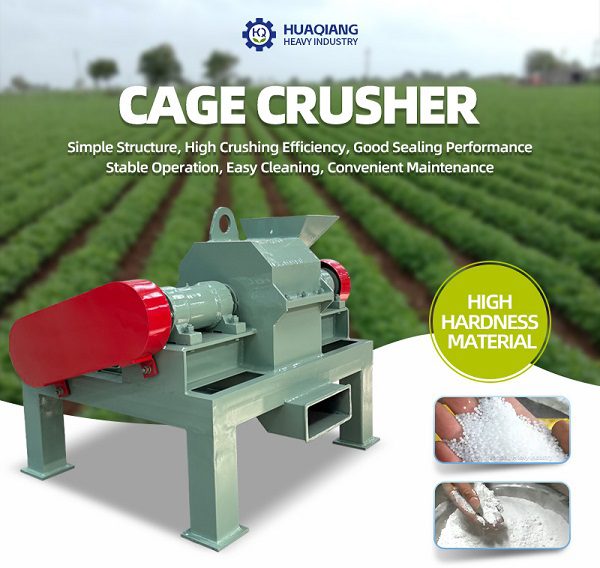
In the field of fertilizer raw material processing machinery, the cage crusher is a specialized solution designed to address one of the most challenging tasks in organic fertilizer production: processing high-fiber, high-toughness materials. Branches, corn cobs, herbal residues, furfural residues, and mushroom waste—these high-fiber raw materials have historically been difficult to crush efficiently, often resulting in low output and unsatisfactory particle size. The cage crusher has changed this situation, becoming an indispensable piece of equipment in medium to large-scale organic fertilizer production lines.
Technical Advantages: The Advantages of the Cage Rotor
The superior performance of the cage crusher stems from its unique double-cage rotor structure and high-speed impact crushing principle. Inside the crushing chamber, the inner and outer cages rotate in opposite directions at high speed, each cage equipped with wear-resistant hammers. As the material enters the crushing chamber and moves within the rotating cages, it is repeatedly subjected to high-speed impacts, shear forces, friction, and inter-particle collisions.
This multi-stage crushing process achieves significant results: output fineness ranging from 20 to 80 mesh, with uniform particle size and no coarse particle residue. This fine and consistent material provides an ideal foundation for subsequent fermentation and granulation processes, significantly improving overall production efficiency.
Compared to chain crushers, cage crushers increase the throughput of fibrous materials by 30%, producing finer particles that are easier to mix with microbial inoculants, potentially shortening the fermentation cycle. While cage crushers are not suitable for high-moisture, viscous materials (semi-wet material crushers excel in this area), they outperform all other crushers for dry, fibrous raw materials.
Core Applications and Process Integration
Cage crushers are primarily used in production lines processing agricultural fiber waste or various mixed raw materials. In medium to large-scale operations, cage crushers typically work in conjunction with other crushers using a “staged crushing” strategy:
For fresh, moist fibrous materials (e.g., corn stalks with a 30% moisture content), semi-wet material crushers perform initial coarse crushing, followed by fine grinding by cage crushers to achieve a suitable particle size for granulation.
For dry fibrous materials (e.g., branches, dried herbal residues), cage crushers can complete the crushing in a single pass. This complementary crushing method overcomes the limitations of a single crusher while maximizing efficiency and fineness, laying a solid foundation for subsequent granulation.
III. Operational Advantages
Cage crushers offer several operational advantages:
Environmentally Friendly: A fully sealed casing prevents dust escape; it can be used in conjunction with bag filters to achieve zero-emission operation.
Stable Performance: Low operating noise and vibration, with minimal site requirements.
Easy Maintenance: Wear parts—hammers and cage bars—are made of high-quality wear-resistant alloys, resulting in longer service life and easier replacement.
Continuous Operation: A processing capacity of 1-10 tons per hour, matching the capacity of disc granulation production lines, allowing for seamless integration.

Increasing Importance in Modern Production
With the expansion of the organic fertilizer industry and the increasing demands for product quality, raw materials such as straw and forage residues are increasingly favored due to their long-lasting fertilizer effects and environmental benefits. Cage crushers can efficiently process these difficult-to-process materials, making them an increasingly important component of fertilizer raw material processing machinery. By transforming tough fibers into uniform, fine particles, cage crushers help manufacturers fully realize the potential of high-fiber raw materials, producing high-quality organic fertilizers for the premium market.
The specialized cage crusher, with its unique ability to process high-fiber materials into uniform, fine particles, is a critical component at the front end of many fertilizer production lines. Its output, with its ideal fineness and consistency, creates a perfectly prepared feedstock for subsequent processes. This prepared material then flows into the heart of a typical npk fertilizer line or an organic fertilizer line. After granulation, the material enters a fertilizer dryer machine to reach the target moisture content for safe storage. It then passes through a fertilizer cooler machine to bring it to ambient temperature, preventing caking. Next, a rotary drum screening machine classifies the granules, ensuring only uniformly sized product moves forward. Finally, the consistent, high-quality granules are precisely weighed and bagged by a fertilizer packing machine. The reliable performance of the initial cage crusher ensures that the entire line, from the first size reduction to the final packaging, operates smoothly and produces a final product that meets the highest market standards.