


In fertilizer granulation production, a key parameter directly determines the efficiency and energy consumption of the production line—the recycled material ratio. Understanding and optimizing it is one of the core means of reducing operating costs.
Definition and Calculation Formula of Recycled Material Ratio
The recycled material ratio refers to the ratio of the amount of material (including fine powder and small particles) returned to the granulator after screening for reprocessing after granulation to the final qualified finished product quantity. It is usually expressed as a percentage:
Recycled Material Ratio = (Recycled Material ÷ Finished Product Quantity) × 100%
For example, if for every 1 ton of qualified granules produced, 0.5 tons of recycled material are returned to the granulator, then the recycled material ratio is 50%. In actual production, the recycled material ratio of rotary drum granulation is usually between 40% and 80%, while that of roller press granulation can be as low as 10% to 25%. A higher recycled material ratio means a greater circulating load, and higher equipment wear and energy consumption.
Main Factors Affecting the Recycled Material Ratio
The recycled material ratio is determined by several variables:
-Raw Material Properties: Materials with poor viscosity, high fine powder content, or unsuitable moisture content are difficult to granulate, naturally increasing the recycled material ratio. For example, high-potassium formulations are more difficult to granulate than high-nitrogen formulations.
-Granulation Process: Steam drum granulation relies on liquid-phase agglomeration. If the steam volume is insufficient or the temperature deviates from the optimal window (55-65℃), the granulation rate decreases, and the recycled material ratio spikes.
-Screening Settings: If the screen mesh is too dense, qualified particles will be mistakenly screened as recycled material, artificially increasing the recycled material ratio; if the mesh is too sparse, substandard particles will be mixed into the finished product, resulting in substandard quality.
-Equipment Condition: Material adhering to the inner wall of the granulator, scraper wear, and nozzle blockage can all disrupt the granulation environment, leading to a surge in recycled material.
III. Mechanical Adjustment Schemes for Optimizing the Recycled Material Ratio and Reducing Energy Consumption
Reducing the recycled material ratio means reducing ineffective material circulation, directly saving energy consumption in crushing, lifting, and drying processes. The following are three core mechanical adjustment measures:
- Precisely control granulator parameters to improve primary granulation rate.
Drum granulation: Stabilize steam pressure at 0.3-0.5 MPa and material temperature at 55-65℃. A “return guide plate” can be installed inside the drum to ensure even distribution of returned fine powder onto the surface of newly formed granules, improving adhesion efficiency. For every 10% increase in primary granulation rate, the return ratio can decrease by approximately 15 percentage points.
Disc granulation: Adjust the disc angle to 42°-45°, rotation speed to 15-16 rpm, and use “intermittent atomization” for liquid spraying. Determine the optimal spray volume and cycle through small-scale testing to avoid excessive wetting leading to breakage of soft granules after screening.
- Optimize the screening system to reduce “false return”.
Use a double-layer grading screen. The upper screen aperture is the upper limit of the target particle size + 0.5 mm, and the lower screen aperture is the lower limit of the target particle size – 0.5 mm. For example, when producing 3-5mm granules, use a 4.5 mesh (approximately 4mm) screen for the upper layer and an 8 mesh (approximately 2.4mm) screen for the lower layer.
Install an online particle size analyzer at the screening machine outlet to provide real-time feedback on screening efficiency. If the proportion of fine powder in the qualified product exceeds the standard, replace the worn screen or adjust the vibration frequency promptly (reduce the frequency from 900 rpm to 800 rpm to increase the screening residence time).
- Design a reasonable return material loop to reduce circulation energy consumption.
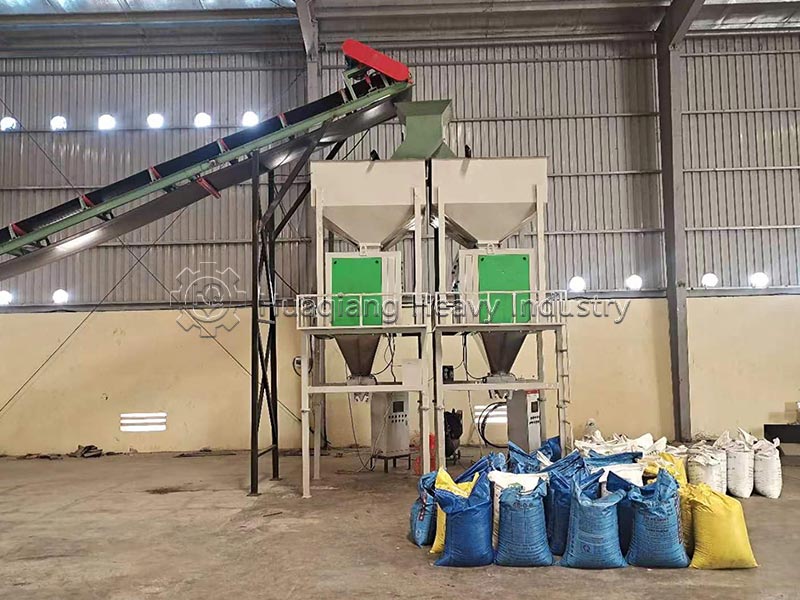
Long-distance lifting should be avoided in the return material conveying process. Return the undersize material directly to the granulator inlet via a belt conveyor to reduce the frequency of bucket elevator use.
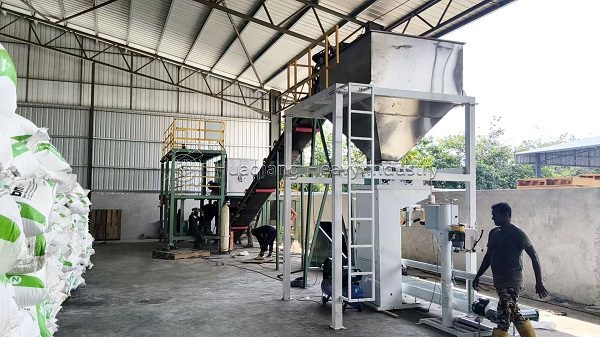
Install a permanent magnet separator and a dispersing device on the return material belt to prevent agglomeration and iron filings in the return material from affecting granulation uniformity.
For formulations with a high return material ratio (>60%), consider diversion: divert some of the return material out of the system as part of the finished product (e.g., for producing low-concentration fertilizers), thereby reducing the load on the main circulation.
The recycled material ratio is not just a process indicator — it directly determines the operating cost and energy efficiency of any fertilizer production line. By integrating advanced fertilizer equipment such as a high-performance fertilizer granulator machine (including the roller press granulator production line which naturally achieves a low recycle ratio of 10–25%) or an organic fertilizer disc granulator with precise angle and speed control, the primary granulation rate can be maximized. Complementing the granulator, a robust fertilizer crusher and mixer ensures homogeneous feedstock and optimal moisture distribution, while accurate fertilizer screening equipment (double‑layer grading screens with online particle size analyzers) eliminates “false return” and reduces the circulating load. Once the granules are qualified, a reliable fertilizer dryer and cooler stabilizes particle strength and moisture content without over‑processing; finally, an automatic fertilizer packing machine guarantees dust‑free, high‑speed bagging. Although industrial fertilizer machine price is always a consideration, long‑term savings from lowering the recycle ratio by 20–30 percentage points (e.g., from 60% down to 40%) can cut power and heat consumption by 25‑30%, offering a rapid return on investment. Therefore, selecting the right equipment combination — from roller press to disc granulation, from crushing/screening to drying/cooling and packing — is the most direct pathway to minimize recycled material, maximize energy efficiency, and achieve stable, premium fertilizer output.
In summary: The return material ratio is a “barometer” of fertilizer granulation efficiency. By precisely controlling granulation parameters, optimizing screening conditions, and designing short-path return loops, the return ratio can be reduced from 60% to below 40%, resulting in a 25%-30% reduction in overall power and heat consumption. Regularly recording the return ratio and establishing process ledgers are fundamental to achieving continuous energy conservation.