
Standardized fertilizer production lines typically employ a straight-line process: raw materials → weighing → mixing → granulation → drying → cooling → screening → packaging. However, actual site conditions vary greatly—limited by factory columns, height restrictions, irregular terrain, or environmental zoning requirements, a straight-line layout cannot be directly implemented. In such cases, non-linear, non-standard customization becomes the inevitable choice. This article compares three types of solutions: L-shaped, U-shaped, and multi-layered vertical layouts, helping users make the optimal decision based on their specific site requirements.
L-shaped Layout: Suitable for Narrow and Corner Sites
When the factory building is long and narrow, but the length is insufficient to accommodate a straight production line, or a turn is required in the middle section, the L-shaped layout is the most commonly used.
Design Considerations: Install a transfer elevator or horizontal belt turning machine at the corner of the production line. For example: the raw material and mixing sections are arranged along axis A, and the granulation and drying sections are arranged vertically along axis B. The turning point is usually chosen between the mixer discharge and the granulator, because powder is easier to turn and transport than granules.
Advantages: Makes full use of factory corners, avoiding the span requirements of long, straight lines. The total equipment length can be reduced by 20%-30% compared to a straight layout.
Limitations: Adding 1-2 transfer devices may generate additional dust or stratification at material inflection points (significantly affecting BB fertilizer).
Applicable Scenarios: Workshops with a length-to-width ratio >3:1 and a narrow width (<8 meters).
U-Shaped Layout: Compact Loop, Same-End Inlet/Outlet
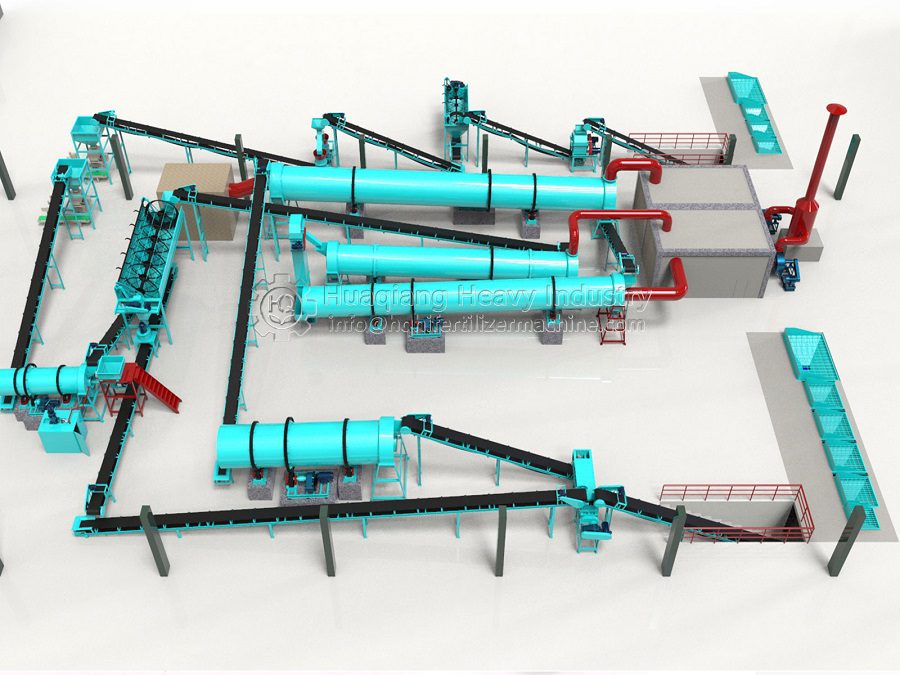
The U-shaped layout places the raw material inlet and finished product packaging on the same side, suitable for sites where “one end is close to a warehouse, and the other end has no road.”
Design Considerations: The first half of the production line (from raw material to granulation) extends forward, while the second half (drying, cooling, screening, packaging) turns back, forming a U-shape. The core connecting equipment is a steep-angle belt conveyor or a Z-type bucket elevator, which lifts the granulated material around the “U-bottom” and sends it into the dryer.
Advantages: Raw materials and finished products are concentrated at one end, reducing forklift transport distance; intermediate process equipment is concentrated on both sides of the U-shape, facilitating centralized dust removal and operational inspection.
Limitations: The total conveying path is 10%-15% longer than a straight line, resulting in slightly increased energy consumption; the bottom of the U-shape requires a larger turning radius (typically ≥4 meters), placing higher demands on factory width.
Applicable Scenarios: Factory length is limited (15-25 meters), but width is ample (≥12 meters), and it is desirable for raw material and packaging areas to be adjacent.
III. Multi-Level Vertical Layout: Vertical Space Reduction When land costs are extremely high or the factory is a multi-story building, a vertical layout is the most efficient solution.
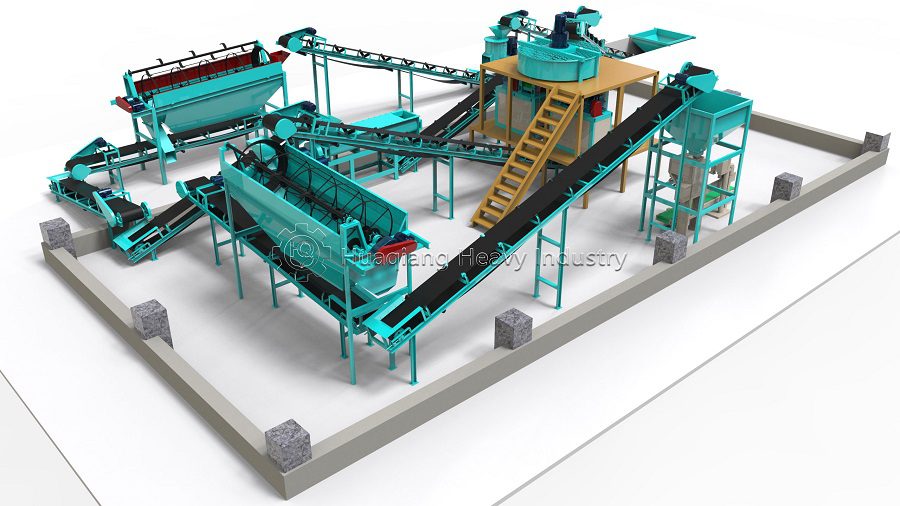
Design Considerations: The production line is broken down into different floors. Typical Solution: The first floor houses raw material weighing and mixing; the second floor houses the granulator and dryer feed ends; the third floor houses cooling and screening; the top floor houses the hot air furnace and dust collector. Materials are conveyed across floors via vertical screw conveyors or bucket elevators, utilizing gravity to flow from high to low.
Advantages: Reduces floor space by 50%-70%, suitable for urban or mountainous factories; materials flow by gravity, reducing the number of horizontal conveying devices.
Limitations: High construction costs, difficult equipment maintenance (requires lifting equipment), and special handling is needed for noise and vibration transmission.
Before designing a non-standard production line, it is recommended to accurately measure the site dimensions and column positions, and mark material inlet/outlet points, dust removal pipe routes, and maintenance access. The core of non-linear processes is not “turning for the sake of turning,” but rather achieving site adaptability while ensuring uniform mixing and reducing material residue and dust. Professional non-standard customization capabilities are often reflected in the meticulous design of elevator angles, chute angles (≥60° to prevent blockage), and pneumatic conveying at turns.
Choosing the right non‑standard layout — L‑shaped, U‑shaped, or vertical — is not merely about fitting equipment into a building; it is about optimizing material flow, minimizing dust, and ensuring maintainability for your specific site constraints. This principle applies to every type of production line. For organic fertilizers, an organic fertilizer disc granulation production line may benefit from a compact U‑shape to keep raw materials and finished products adjacent, while a bio organic fertilizer production line often requires additional space for post‑fermentation curing, which a vertical layout can accommodate without expanding the footprint. For high‑density compound fertilizers, a roller press granulator production line or a npk fertilizer production line can adopt an L‑shape to navigate narrow workshops, with the turning point placed after mixing to preserve granule integrity. In all cases, the selection of core fertilizer equipment — especially the fertilizer granulator machine — must align with the layout: a drum granulator may require more headroom, while a disc granulator is more flexible for multi‑floor installation. Ultimately, the goal is to achieve a seamless, energy‑efficient process where materials flow smoothly without excessive lifting or long‑distance conveying. With careful planning of transfer angles, chute slopes, and dust control points, even the most irregular workshop can house a high‑performance, reliable production line that meets both quality and capacity targets.
Summary: There is no best layout, only the solution that best matches the site. L-shaped, U-shaped, and vertical layouts each have their advantages and disadvantages. By rationally selecting and matching appropriate transfer equipment, even irregularly shaped workshops can be transformed into efficient and stable fertilizer production lines. We specialize in custom design of non-standard fertilizer production lines, providing complete solutions for L-shaped, U-shaped, and multi-layered vertical layouts. Whether it’s a narrow corner or a three-dimensional space, our professional team can handle everything from site surveying to meticulous design of transfer equipment, ensuring that even your irregularly shaped factory can produce a highly efficient and stable fertilizer production line.