
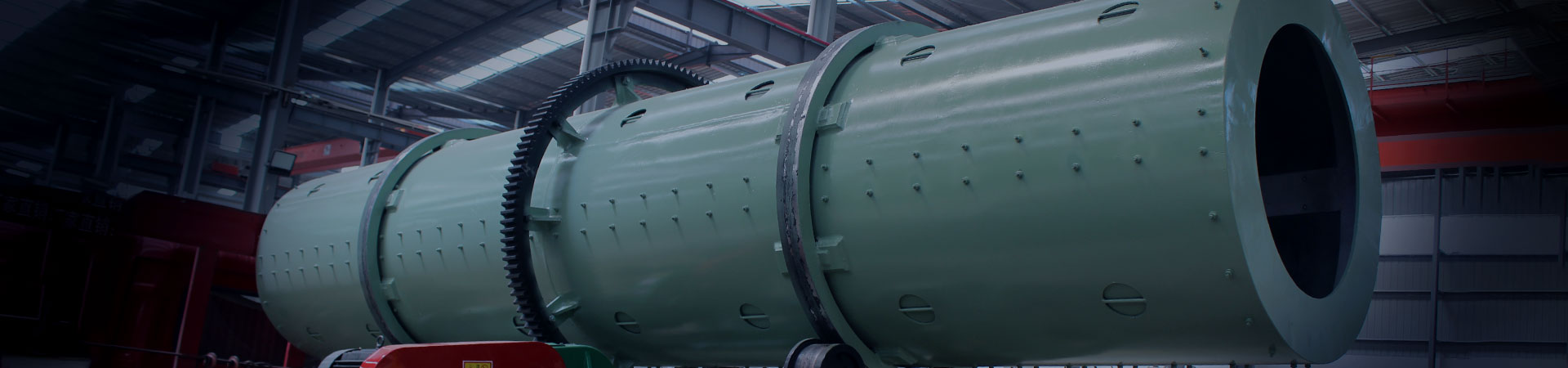
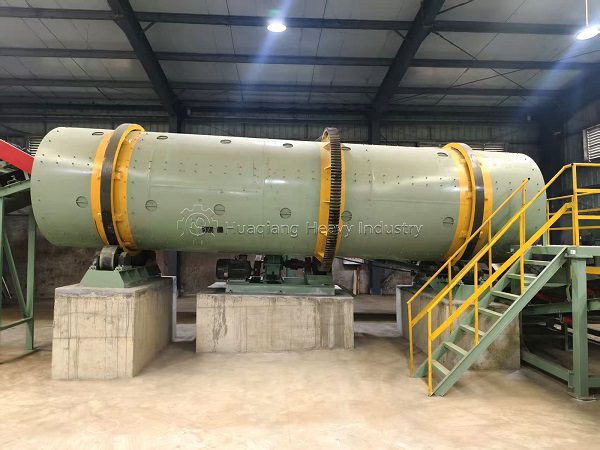
Rotary drum granulators are key equipment in the production of compound fertilizers and organic fertilizers. The choice of lining material directly determines granulation efficiency, equipment lifespan, and maintenance costs. Currently, the mainstream solutions are rubber linings and acid-resistant stainless steel linings. The two differ significantly in four dimensions: anti-sticking properties, wear resistance, replacement costs, and coefficient of thermal expansion. This article analyzes each dimension in detail.
Anti-sticking Properties: Rubber’s Elastic Self-Cleaning, Stainless Steel’s Reliance on Smoothness
Rubber linings have a natural advantage in anti-sticking. The elasticity of rubber causes it to undergo slight deformation during drum rotation, automatically “shaking” off adhering materials, achieving automatic removal of scabs and nodules without the need for traditional scraper devices. Materials such as neoprene rubber also have good acid and alkali resistance, effectively preventing corrosion of the drum wall by salt and moisture in fertilizers.
Stainless steel linings have a smooth surface, making initial material adhesion difficult. However, once scabs form on the wall, the lack of elastic deformation in metal prevents automatic removal, requiring a scraper device for cleaning. For highly adhesive organic fertilizers or high-nitrogen compound fertilizers, stainless steel liners are significantly less effective at preventing sticking than rubber.
Conclusion: Rubber liners are far superior in preventing sticking.
Wear Resistance: Rubber is flexible and wear-resistant, while stainless steel is rigid and scratch-resistant.
Rubber liners have excellent wear resistance and shock absorption properties, effectively reducing wear when the drum comes into contact with the raw materials. The flexibility of rubber can alleviate equipment pressure and reduce metal loss during high-load operation. Under sliding wear and low impact stress conditions, rubber’s wear resistance is even better than steel.
Stainless steel liners have high hardness and structural strength, maintaining stability during long-term high-load operation. When handling materials containing hard particles (such as phosphate rock powder and unscreened return material), stainless steel has better scratch resistance than rubber.
Conclusion: Choose rubber for sticky, low-wear materials; choose stainless steel for hard, high-wear materials.
Replacement Cost: Rubber is economical and convenient, while stainless steel requires a high initial investment.
Installation and replacement of rubber liners are relatively simple, requiring no complex tools or specialized technicians. Under the same operating conditions, rubber liners can last from 18 months to over 2 years. However, their high-temperature resistance is poor (recommended operating temperature ≤70℃), and they are prone to aging and cracking in high-temperature environments, increasing replacement frequency.
Stainless steel liners have a significantly higher initial investment than rubber, but a longer service life. In corrosive environments, stainless steel is not prone to rust and can maintain its surface condition for a long time. However, its weight is greater, increasing equipment load and energy consumption.
Conclusion: Choose rubber for short-term investment, and stainless steel for long-term operation and highly corrosive environments.
Coefficient of Thermal Expansion: Rubber is sensitive and requires temperature control, while stainless steel is stable and resistant to high temperatures.
Rubber liners have a much higher coefficient of thermal expansion than metals, resulting in significant dimensional changes with temperature variations. When the temperature rises from room temperature to above 70℃, rubber may deform, age, or even crack due to thermal expansion and contraction. Therefore, strict temperature control is required during steam granulation (material temperature 55-65℃).

Stainless steel liners have a low coefficient of thermal expansion (approximately 7.2×10⁻⁶ m/m·K), are dimensionally stable at high temperatures, and are suitable for steam granulation and hot operating conditions. Metal liners exhibit significantly superior high-temperature resistance compared to rubber.
Conclusion: Rubber liners are preferred for room-temperature or low-temperature granulation; stainless steel liners are essential for steam granulation or high-temperature applications.
Selection Summary: Rubber liners are preferred for: organic fertilizers, viscous materials, room-temperature granulation, and applications requiring low maintenance costs and excellent anti-sticking properties.
Stainless steel liners are preferred for: compound fertilizer steam granulation, high-temperature applications, materials containing hard particles, and applications requiring long-term stability and corrosion resistance.
We specialize in the R&D and manufacturing of rotary drum granulators and liner systems, offering customized solutions for both rubber and stainless steel liners. From material analysis to operating condition matching, our professional team provides precise selection, ensuring the granulator achieves optimal anti-sticking, wear-resistant, and high-temperature resistance for optimal efficiency.
The selection of a rotary drum granulator liner is not a trivial component choice—it is a strategic decision that directly influences the efficiency, reliability, and operating cost of the entire fertilizer production train. Whether you opt for the self‑cleaning, cost‑effective rubber liner for sticky organic materials, or the high‑temperature, wear‑resistant stainless steel liner for aggressive compound fertilizer steam granulation, the right match ensures that the rotary drum granulator performs at its peak, delivering uniform, high‑strength granules. This granulator, as the core fertilizer granulator machine, works in concert with upstream fertilizer crusher and mixer for homogeneous feed preparation, and downstream fertilizer dryer and cooler to lock in moisture and strength, finally leading to the automatic fertilizer packing machine for dust‑free bagging. While the industrial fertilizer machine price may tempt operators to choose the cheaper liner option, the long‑term implications—downtime for liner replacement, energy loss from poor granulation, and product quality issues—often outweigh the initial savings. A properly selected liner extends equipment life, reduces maintenance frequency, and ensures consistent product quality across the entire fertilizer equipment line. In short, investing time in material analysis and operating condition matching for the liner is one of the most cost‑effective decisions a fertilizer producer can make—protecting both the granulator and the profitability of the whole plant.