
As organic fertilizer production transitions from small-scale workshops to large-scale operations, with daily processing capacity leaping from a few tons to hundreds of tons, the crushing process is no longer a single-machine operation but a system engineering project requiring precise coordination. For medium to large-scale production lines with a capacity of 10 tons/hour or more, how to efficiently coordinate multiple crushers and seamlessly integrate them with fermentation and granulation processes directly determines the overall operating efficiency and final benefits of the line. Huaqiang Heavy Industry, deeply rooted in the organic fertilizer equipment field, has launched multi-machine collaborative crusher solutions to meet the needs of large-scale production, helping users achieve full-process automation from raw materials to finished products. This article will use two mainstream solutions as examples to explain in detail how to create a high-efficiency, high-yield production line through multi-machine combinations.
The Core Logic of Large-Scale Production: From “Single Machine” to “System”
In small-scale production, a single crusher often handles all tasks—regardless of whether the raw material is dry or wet, coarse or fine, it’s all “handled by one machine.” However, this model is unsustainable in large-scale production. There are three reasons:
Efficiency Bottleneck: A single piece of equipment cannot simultaneously handle both coarse and fine grinding, inevitably becoming a bottleneck in the entire production line at some point.
Process Conflict: High-moisture materials require low speed and large gaps, while drying hard lumps requires high speed and strong impact; a single piece of equipment cannot meet both simultaneously.
Failure Risk: A single machine failure leads to a complete production line shutdown; large-scale production cannot withstand this uncertainty.
Therefore, the grinding process in large-scale production lines must move towards a “multi-machine linkage, division of labor and cooperation” model—different equipment performs its specific function, seamlessly connected through an automated system to achieve a synergistic effect of 1+1>2.
Solution One: Granular Organic Fertilizer Production Line—Three-Step Grinding, Precise Connection
Pellet organic fertilizer is currently a mainstream product in the market. Its production process includes multiple stages such as raw material pretreatment, fermentation, secondary grinding, granulation, drying, cooling, and screening. The grinding process runs throughout, requiring three pieces of equipment to work in succession.
First Step: Straw Crusher—The Starting Point for Carbon-Nitrogen Ratio Adjustment
The first step in pellet fertilizer production is to grind the collected coarse fiber raw materials such as straw and rice husks to adjust the carbon-nitrogen ratio. The Huaqiang straw crusher shreds corn stalks, wheat straw, etc., to an ideal length of 3-5 cm, and then directly feeds them into the mixing zone via a belt conveyor. Equipped with a forced feeding device, the equipment can handle bundled or loose straw, with a processing capacity of 5-10 tons per hour, ensuring a sufficient supply of raw materials.
The second stage: Horizontal Crusher – The “Central Kitchen” for Mixed Raw Materials
The crushed straw and fresh manure (or auxiliary materials) are fed into the Huaqiang horizontal crusher in a specific ratio. This equipment simultaneously performs the dual tasks of crushing and mixing – under the high-speed impact of the hammer blades, the straw and manure are further kneaded and mixed, achieving a uniform state where each component is present. The output is a uniformly mixed fermentation raw material with a balanced carbon-nitrogen ratio, which can be directly fed into the fermentation tank or fermentation vessel. One user reported that after adopting the horizontal crusher, the process that previously required two machines and two transfers is now completed in one step, increasing efficiency by 40%.
The third step: Semi-wet material crusher – “refining” after fermentation
After fermentation, the composted material, although its organic matter has stabilized, often clumps together and must be crushed again before entering the granulation stage. Huaqiang’s semi-wet material crusher specializes in this task, processing wet materials with a moisture content of 25%-50%, breaking down clumps to an ideal fineness of 20-40 mesh. The output is directly fed into the granulator hopper via an elevator, achieving a seamless connection. The equipment adopts a dual-stage rotor structure, eliminating clogging, and a single machine can achieve an hourly output of 10-20 tons, fully matching the needs of large-scale granulation lines.
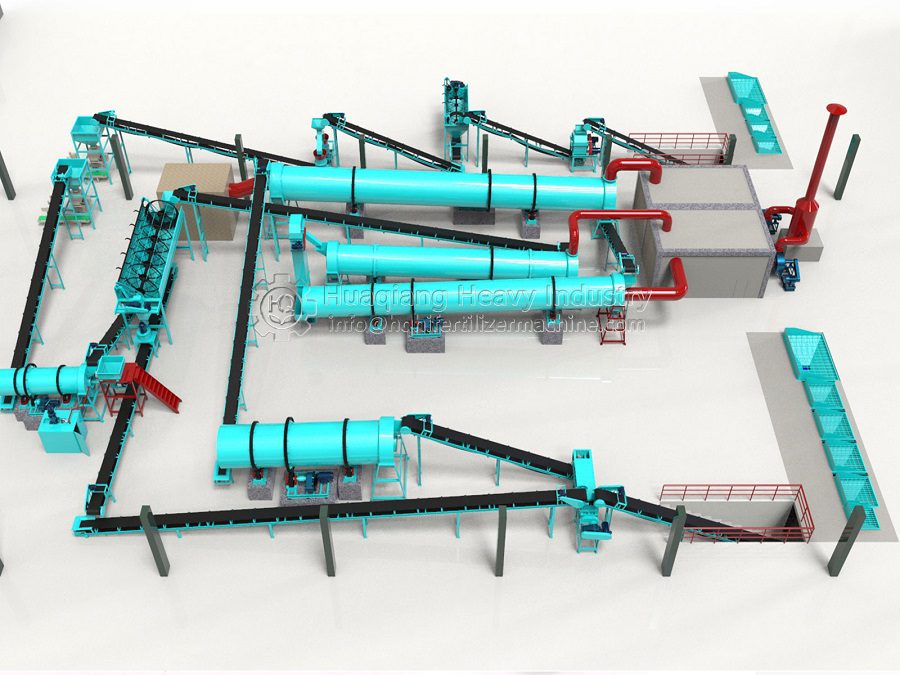
Three machines working in tandem, belt conveyor: Three machines are connected via belt conveyors and elevators to form an automated production line. Straw crusher → horizontal crusher → fermentation zone → semi-wet material crusher → granulator. The entire process involves no material touching the ground, requiring only 1-2 inspection personnel, truly achieving “automated production.”
Option 2: Powdered Organic Fertilizer Production Line – Coarse and Fine Powdering in One Step
The production process of powdered organic fertilizer is relatively simple, but it requires a higher degree of fineness in grinding. Large-scale production also requires the collaboration of multiple machines.
First Stage: Chain Crusher – The “Pioneer” of Hard Lumps
If the decomposed raw material is severely caking, directly feeding it into the fine grinding equipment can easily cause overload. The Huaqiang chain crusher, as the first stage, uses powerful impact force to coarsely crush large pieces of material to 20-40 mesh, while removing any small amounts of hard impurities that may be mixed in. It can process 10-15 tons of raw material per hour, providing a stable material supply for subsequent fine grinding.
Second Stage: Cage Crusher – The “Artist” of Fine Grinding
The coarsely crushed material enters the Huaqiang cage crusher, where it repeatedly impacts and rubs between two relatively rotating cages, ultimately being ground into an ultrafine powder of 60-80 mesh. The equipment is equipped with a fineness adjustment device, which can flexibly adjust the output fineness according to product positioning. With a single-machine output of 5-8 tons per hour, it forms a golden combination of “coarse crushing + fine grinding” with a chain crusher.
Integrated screening and closed-loop operation: A vibrating screen is installed after the cage crusher. Qualified fine powder enters the packaging machine, while unqualified coarse particles are automatically returned to the chain crusher for reprocessing, forming a closed-loop cycle with a raw material utilization rate of over 98%. The entire system, from feeding to packaging, requires only 3-4 operators.
Case Study: An Efficiency Revolution in a 20-ton/hour Production Line
A large organic fertilizer plant’s original production line used a single-machine operation mode: one crusher processed all raw materials, requiring workers to frequently switch materials and clear blockages. Daily processing capacity hovered around 50-60 tons, and product quality was unstable. After introducing Huaqiang Heavy Industry’s multi-machine linkage solution, the plant underwent a complete transformation:
Capacity leap: The new line’s designed capacity is 20 tons/hour, with a daily processing capacity exceeding 150 tons, three times that of the previous line.
Labor Reduction: From raw material input to finished product packaging, the entire process requires only 4 operators, a 60% reduction compared to before the upgrade.
Efficiency Increase: The automated production line eliminates material transfer and waiting time, increasing overall production efficiency by over 50%.
Quality Consistency: Multi-stage crushing ensures the raw material fineness remains within the optimal range, with a granulation rate consistently above 95%.
Customized Services: Tailoring Solutions to Your Capacity
Every organic fertilizer plant has different capacity targets, raw material characteristics, and site conditions. Huaqiang Heavy Industry offers a series of supporting solutions ranging from 10 tons/hour to 50 tons/hour, which can be deeply customized to your specific needs:
Capacity Matching: Based on the target daily processing capacity, the specifications and quantity of each crusher are precisely calculated to avoid over-engineering or under-engineering.
Raw Material Adaptation: For different raw material compositions, such as chicken manure-based, cow manure-based, or high straw content, equipment selection and parameter settings are optimized.
Layout Optimization: Based on the site dimensions, we design the most compact layout, maximizing space utilization while ensuring ample operating space.
From single-machine operation to multi-machine linkage, from manual operation to automated operation—the evolution of large-scale organic fertilizer production lines is essentially a victory of systems thinking. Huaqiang Heavy Industry not only provides high-performance individual machines but is also committed to creating complete production line solutions for you, from crushing to finished products. When your production line is running stably at a capacity of 20 tons per hour, and processes that once required a dozen workers can now be completed by just a few, you will understand that multi-machine linkage is not merely an upgrade of equipment, but a comprehensive improvement in efficiency and effectiveness.
The multi-machine crushing solutions described for organic lines are equally applicable, with adaptations, to a complete npk fertilizer line. Following granulation, regardless of whether the product is organic or NPK, the material requires a series of finishing steps. The moist granules from the granulator are first fed into a fertilizer dryer machine, which reduces moisture to the target level (typically below 2-5%) for safe storage. The hot, dry granules then pass through a fertilizer cooler machine to bring them down to near-ambient temperature, preventing caking in the bags. Next, a rotary drum screening machine classifies the granules, separating the perfectly sized product from oversize and undersize material, which is recycled. Finally, the consistent, high-quality granules are precisely weighed and sealed into bags by a fertilizer packing machine. This integrated post-granulation system—drying, cooling, screening, and packaging—is essential for transforming the output of any granulator into a stable, market-ready fertilizer product.