

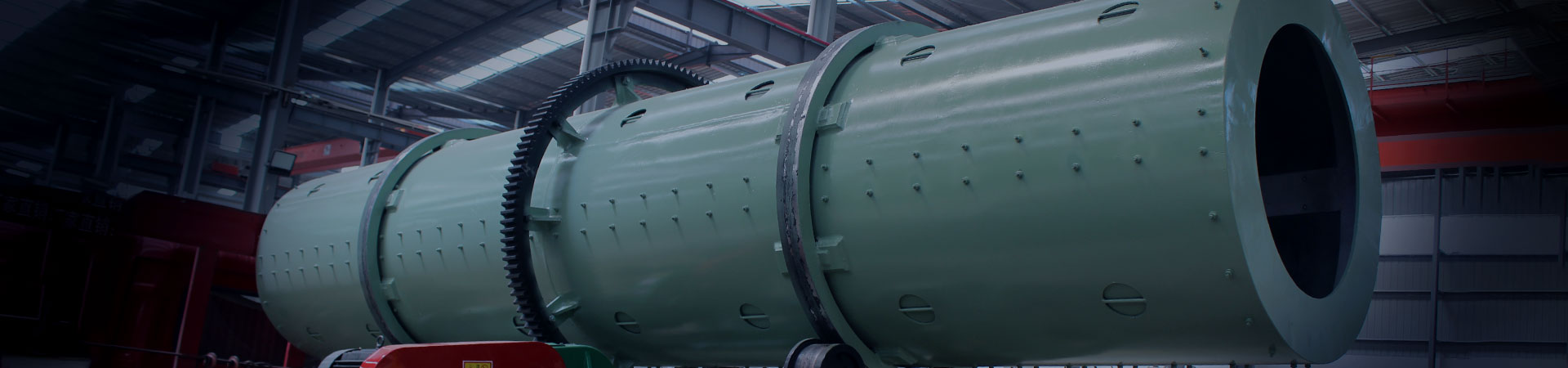
In BB fertilizer production, the operational stability of blending equipment directly determines product quality. Insufficient mixing uniformity leads to excessive nutrient deviation, material stratification causes particle segregation, and discharge blockage brings the entire production line to a standstill. Faced with these high-frequency faults, operators who master the rapid troubleshooting logic of “phenomenon → cause → solution” can minimize downtime losses.
Fault 1: Low Mixing Uniformity, Nutrient Variation Coefficient > 5%
This is the most common fault in blending equipment, manifested as uneven distribution of nitrogen, phosphorus, and potassium components in the finished product, with large fluctuations in multi-point sampling test values. The core cause points first to differences in material characteristics—when raw material particle size and density differ significantly, such as urea (1.33g/cm³) and potassium chloride (1.98g/cm³), direct mixing easily leads to particle separation due to different physical properties. Secondly, impeller wear is a key equipment factor; when impeller wear exceeds 5mm, the driving force decreases, and the material cannot be fully convected. In addition, insufficient mixing time (<3 minutes) or improper feeding sequence can also cause problems.
Quick Solution: After stopping the machine, check the wear of the impeller blades. Replace or repair any severely worn blades promptly. Adjust the feeding sequence, following the principle of “heavy before light, large before small.” Extend the mixing time to 5-8 minutes using the PLC, and resume mass production only after sampling and testing to ensure uniformity meets standards.
Fault 2: Material Segregation and Uneven Output Composition
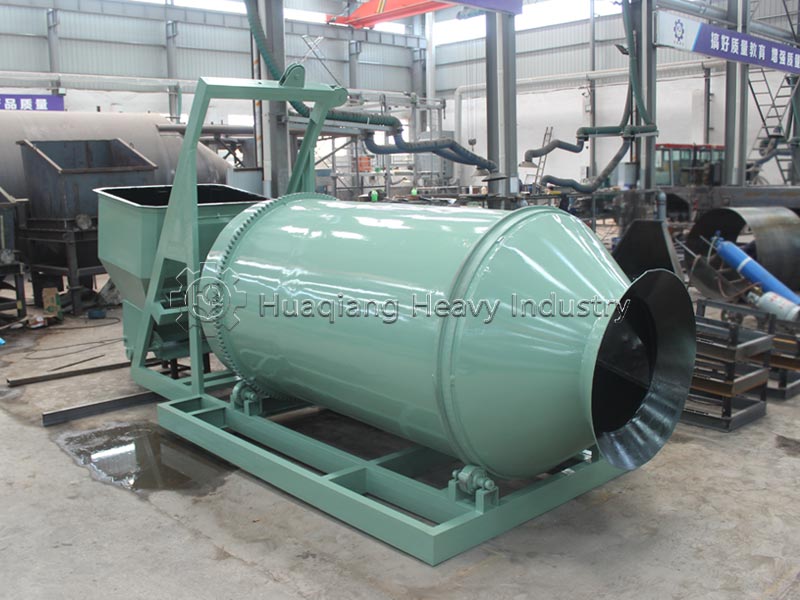
Material stratification manifests as a significant difference in nutrient content between the front and rear sections during unloading, often due to excessive differences in material specific gravity and improper post-mixing processing. During filling, if the material falls freely and forms a cone, coarser particles will roll to the edges, while finer powder will concentrate in the center, causing segregation. Regarding equipment, an unreasonable unloading method—rapid, one-time emptying—exacerbates stratification.
Quick Solution: Improve the unloading operation by adopting a segmented unloading mode—unload 1/3 first, then pause for 30 seconds to allow the remaining material to tumble and mix again before continuing discharge. Installing anti-segregation baffles or conical mixing devices inside the silo can effectively suppress segregation during filling. Simultaneously, ensuring similar particle size distributions of all raw materials (SGN index matching) reduces the risk of segregation at the source.
Fault 3: Discharge blockage, frequent equipment overload. Material sticking to the walls and agglomerating is the main cause of blockage, commonly seen when processing raw materials with a moisture content exceeding 15%. Wet material adheres to the chamber walls and blades, forming a thick layer that eventually blocks the inlet and outlet. Insufficient clearance between the impeller and the shell (designed 5-8mm, actually reduced to 2mm after wear) can also cause material to get stuck.
Quick solution steps: Immediately stop the machine and use a high-pressure air gun to blow away residual material in the mixing chamber; check and adjust the impeller-shell clearance to the design value; strictly control the raw material moisture content to ≤12%, adding a drying process if necessary. For production lines with frequent blockages, a vibrating screen can be installed at the inlet to remove large impurities in advance.
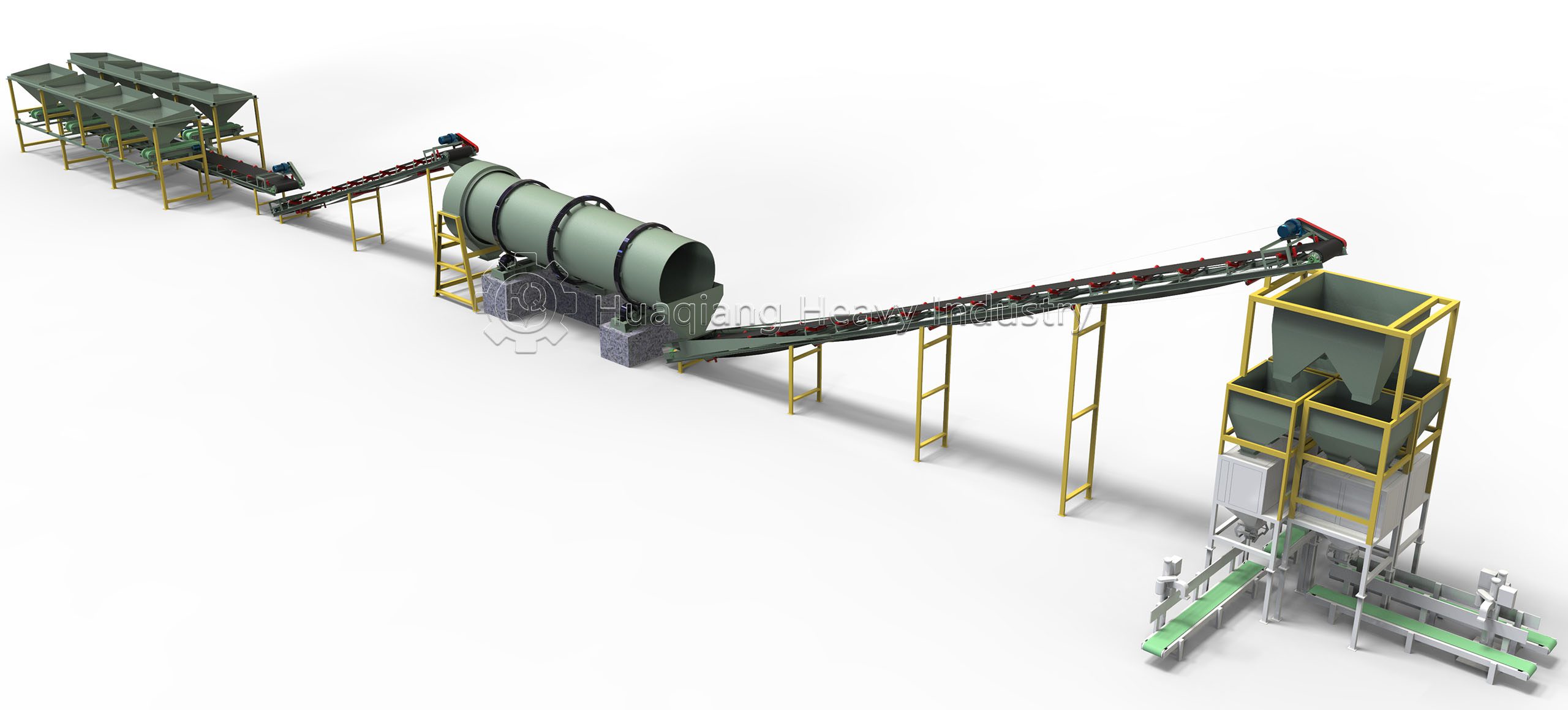
In daily operation, cleaning residual material and checking the tightness of impeller bolts daily can prevent 80% of common faults. Our blending equipment comes standard with a self-diagnostic system—using torque sensors to monitor load changes in real time. When early signs of blockage are detected, the system automatically slows down and reverses to clear the blockage, pushing a warning message to the central control screen. For mixing uniformity, the system records the stirring current curve for each batch and compares it with a standard curve. If the deviation exceeds the standard, it indicates impeller wear or abnormal parameters.
The troubleshooting guide for BB fertilizer blending equipment is essential, but it’s also important to consider how these issues can affect downstream processes in a complete npk fertilizer line. After a uniform blend is achieved by a reliable npk blending machine, the product typically moves directly to packaging. However, if the BB line includes a granulation step for enhanced physical properties, the post-blending material might be fed into a rotary drum screening machine for initial classification, or perhaps into a fertilizer dryer machine and fertilizer cooler machine for moisture and temperature control. Ultimately, the consistent, high-quality granules are precisely weighed and bagged by a fertilizer packing machine. A fault in the upstream npk blending machine—such as poor mixing uniformity or segregation—can create significant problems for these downstream processes. Inconsistent feed can overwhelm a dryer, cause blockages in a cooler, and lead to unacceptable variations in the final packaged product. Therefore, mastering the troubleshooting of the npk blending machine is not just about maintaining a single piece of equipment, but about safeguarding the quality and efficiency of the entire production line.
From accurate diagnosis to rapid resolution, understanding the underlying logic of equipment failures allows us to turn every downtime into an opportunity to optimize production. For complex faults, please feel free to contact our after-sales technical team for remote support.