

What is Fertilizer Plant Dust?
Fertilizer plant dust refers to the phenomenon of solid particulate matter suspended in the air during fertilizer production processes, generated from material crushing, mixing, granulation, drying, sieving, and conveying. The main components of this dust are raw material powder, finished fine powder, and trace additives, with particle sizes typically ranging from 0.5 to 200 micrometers. Dust not only causes material loss but also poses a dust explosion risk and is a core assessment indicator for environmental protection acceptance.
Source Control: Enclosed and Negative Pressure Design
The optimal strategy for dust control is direct suppression at the point of generation. For dust-generating equipment such as crushers, sieves, and mixers, it is recommended to install fully enclosed dust covers. The cover body should be welded from 2-3 mm thick steel plates, and the observation window should use double-layered tempered glass. A slight negative pressure (50-100 Pa) should be maintained inside the cover, and the dust-laden gas should be drawn to the dust removal system through the suction vents. In the conveying process, guide chutes should be installed at the receiving and unloading points of belt conveyors. The length of the guide chutes should be no less than 1.5 meters, and double-layered dustproof rubber curtains should be installed inside. Both the head and base of the bucket elevator should be equipped with air intakes—the dust concentration is highest at the head, and the intake volume should account for more than 60% of the total. Through source-sealed design, the amount of fugitive dust emissions in the workshop can be reduced by 60% to 70%.

Dust Removal Equipment Selection: Cyclone and Bag Filter Synergy
For the characteristics of fertilizer dust (medium particle size, some hygroscopicity), a two-stage dust removal system in series is recommended. The first stage is a cyclone separator, which uses centrifugal force to separate and recover coarse particles larger than 10 micrometers. The inlet velocity of the cyclone separator is recommended to be controlled at 15 to 18 meters per second, with a separation efficiency of 80% to 90%. The recovered coarse powder can be directly returned to the production line. The second stage is a pulse-jet bag filter, used to collect the remaining fine particles. For filter bags, it is recommended to choose oil- and water-resistant polyester needle-punched felt with a maximum temperature resistance of 120 degrees Celsius. The air-to-cloth ratio (air volume handled per square meter of filter bag) should be controlled at 0.8 to 1.2 cubic meters per square meter per minute, with a cleaning pulse pressure of 0.4 to 0.6 MPa and a pulse interval of 30 to 60 seconds. The overall dust removal efficiency after two stages in series can reach over 99.5%, with an outlet emission concentration of less than 30 milligrams per cubic meter.
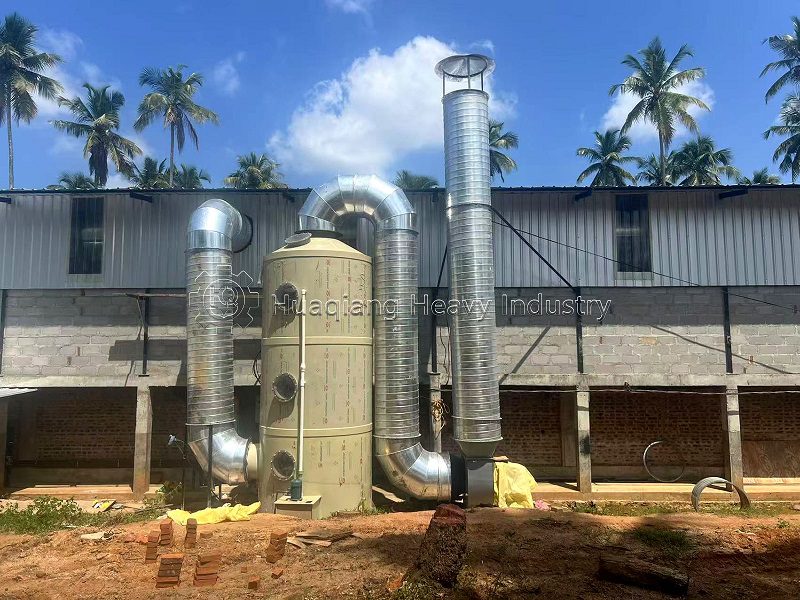
III. Wet Dust Collection and Explosion-Proof Measures For high-temperature and high-humidity dust-laden gases (temperature 80 to 110 degrees Celsius, relative humidity above 60%) generated during the drying process, baghouse dust collectors are prone to bag clogging. In this case, a wet scrubbing tower should be used as an alternative. The dust-laden gas enters from the bottom of the tower and comes into counter-current contact with the water mist sprayed from the top. The dust is captured by the liquid droplets and settles to the bottom of the tower. The empty tower gas velocity of the scrubbing tower is controlled at 1.0 to 1.5 meters per second, the liquid-to-gas ratio is 2 to 3 liters per cubic meter, and the outlet emission concentration can be controlled below 50 milligrams per cubic meter. The scrubbing wastewater is treated in a sedimentation tank and then recycled. The settled sludge is dewatered by a plate and frame filter press and returned to the batching system. Meanwhile, fertilizer dust (especially urea-based and organic fertilizer-based dust) poses an explosion risk; therefore, the dust removal system must be equipped with explosion vents—the explosion vent area is calculated at 0.1 to 0.2 square meters per cubic meter of volume, the static opening pressure of the explosion vent should not exceed 0.01 MPa, and the vents should be directed to a safe outdoor location.
Key Points for Pipeline Design and Maintenance: The design of the dust removal pipeline directly affects the system’s performance. It is recommended to maintain a main pipeline air velocity of 15 to 20 meters per second—too low a velocity will cause dust settling and blockage, while too high a velocity will wear down elbows. Horizontal pipelines should have a slope of not less than 5 degrees, and a cleaning port should be installed every 6 to 8 meters. The radius of curvature of the elbow should be no less than twice the pipe diameter, and the inner wall should be lined with wear-resistant ceramic plates. Check the pipe dust accumulation monthly, and clean the dust hopper of the bag filter quarterly—it must be cleaned when the dust accumulation in the hopper exceeds two-thirds of its height, otherwise it will clog the return material system.
Targeted Configuration for Different Processes: For the crushing and screening processes, dust generation points are concentrated and the dust concentration is high (10 to 30 grams per cubic meter). It is recommended to equip each machine with an independent small bag filter, and the recovered powder can be directly returned to the process line via a screw conveyor. The drying process generates large volumes of high-temperature exhaust gas; cyclone separators should be prioritized to recover coarse powder (approximately 70% of the dust at the dryer outlet is finished product particles), followed by exhaust gas treatment using a scrubbing tower. The packaging process generates dispersed dust points but with lower concentrations (1 to 5 grams per cubic meter), which can be treated uniformly using a central dust collection system. The filling port of the packaging machine should be equipped with a ring-shaped suction hood with an air volume of 3 to 5 cubic meters per minute to control dust below the operator’s breathing zone.
Dust Management as a Production Line Imperative
Effective dust control in fertilizer manufacturing extends far beyond regulatory compliance—it is an integral component of process efficiency, product recovery, and workplace safety. Every unit operation within a modern fertilizer equipment train generates particulate matter: the fertilizer granulator machine—whether a steam-assisted rotary drum or an organic fertilizer disc granulator—releases fines during agglomeration; the fertilizer dryer and cooler exhaust carries entrained powder at concentrations up to 30 g/m³; and the fertilizer screening equipment produces concentrated dust streams at both oversize and undersize discharge points. Even the automatic fertilizer packing machine generates dispersed respirable dust during bag filling. By implementing source-enclosed designs with slight negative pressure, coupled with a two-stage recovery train comprising a cyclone dust collector for coarse particle recovery and a pulse-jet bag filter for fine particulate capture, manufacturers can achieve >99.5% removal efficiency while returning recovered material directly to the process line. This integrated approach transforms dust from a costly waste stream and explosion hazard into a closed-loop resource, simultaneously protecting worker health, satisfying environmental inspectors, and improving overall plant economics.
We provide a complete set of dust control equipment, including sealed dust covers and two-stage cyclone bag filters. We can also customize the dust collection system layout and explosion-proof and venting solutions free of charge according to the characteristics of your dust-generating processes and environmental emission standards, helping you to stably control the dust concentration and exhaust gas emissions in your workshop within the acceptable range.