
In the field of fertilizer and chemical granulation, hydraulic roller granulators, with their precise pressure control and superior particle strength, are becoming an increasingly important focus for technical procurement personnel. Compared to ordinary roller press granulators, the introduction of a hydraulic system is not only an upgrade in power source but also a technological leap from “mechanical extrusion” to “intelligent compaction” in the granulation process. This article will deeply analyze the core technology of hydraulic roller granulators.
The essential difference between hydraulic roller granulators and ordinary roller press granulators lies in the pressure control method. Ordinary equipment uses mechanical springs or fixed gaps, and the pressure varies with material fluctuations, making it difficult to ensure uniform particle density. Hydraulic roller granulators, on the other hand, drive floating rollers with hydraulic cylinders. The hydraulic system can adjust and maintain the set pressure in real time, automatically compensating for fluctuations in material hardness to ensure that each particle withstands the same extrusion intensity. This design allows the particle density variation coefficient to be controlled within 5%, and the forming rate to be stable above 95%.
The granulation process of a hydraulic roller granulator can be summarized as a four-step closed loop: “feeding—extrusion—forming—screening”. Raw materials must be pre-treated to a moisture content ≤5% and a fineness of 80-200 mesh, and then uniformly fed into the gap between the two rollers via a forced feeding screw. A pair of rollers rotate in opposite directions, with the fixed roller remaining in a fixed position, while the floating roller is subjected to adjustable pressure (typically 5-30 MPa) by a hydraulic system. The material undergoes a gradient-increasing compression process between the rollers: first, it is bitten into the roller gap, then undergoes plastic deformation in the high-pressure zone, maximally compressing the voids between particles and increasing density by 1.5-3 times. The compacted flaky material is then broken up by a crusher and classified by a screening system. Qualified particles enter subsequent processes, while fine powder is returned for re-extrusion, achieving zero-emission continuous production.
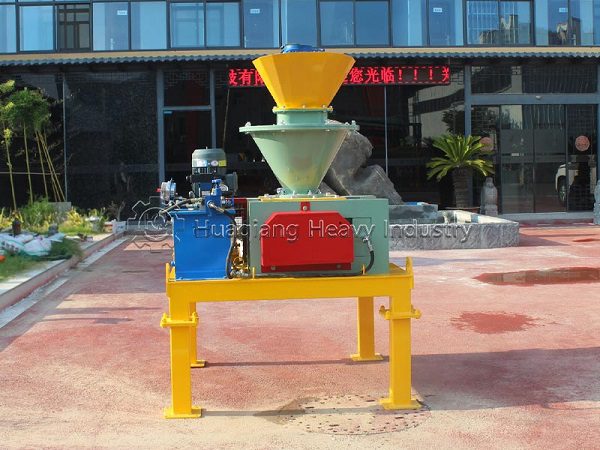
Hydraulic system pressure control is the core of the system. The hydraulic station precisely controls the oil pressure through proportional valves, with a response time in milliseconds, ensuring constant roller pressure. Our equipment supports custom pressure adjustment, accurately adaptable to materials ranging from low viscosity (5-10 MPa) to high hardness (25-30 MPa). Matching the roller speed is equally crucial, typically adjustable from 10-25 r/min, and linked to the feeding speed to prevent insufficient material filling or overloading. The principle of plastic deformation in materials lies in the fact that when the pressure exceeds the material’s yield strength, the particles undergo irreversible deformation, the intermolecular distance decreases, and van der Waals forces and crystal bridges bind the particles into a dense mass.
The introduction of a hydraulic system brings three core advantages: stable pressure ensures uniform particle density, with a strength deviation of ≤±2N for the same batch of particles; high forming rate, with a return rate controllable to within 15%, a reduction of 5-8 percentage points compared to mechanical equipment; and wide raw material adaptability, handling a wide range of materials from ammonium sulfate (easy to form) to phosphate rock powder (high hardness) through pressure adjustment.
Our hydraulic roller granulator uses independent hydraulic control for both rollers, with a pressure adjustment range of 0-30MPa, supporting formula parameter storage and one-click recall. The roller surface is made of high-chromium wear-resistant alloy, vacuum quenched, with a service life of over 8000 hours. The hydraulic system is equipped with a standard air-cooling device to ensure that the oil temperature is ≤55℃ during continuous operation. For overseas users, the equipment supports dual voltage configurations of 380V/50Hz and 460V/60Hz to meet the power grid requirements of different regions. From potassium sulfate to ammonium chloride, from catalysts to metallurgical powders, the hydraulic roller granulator, with its unique advantages of precise pressure control, stability, and high efficiency, is becoming a technological benchmark in the field of high-end powder granulation.
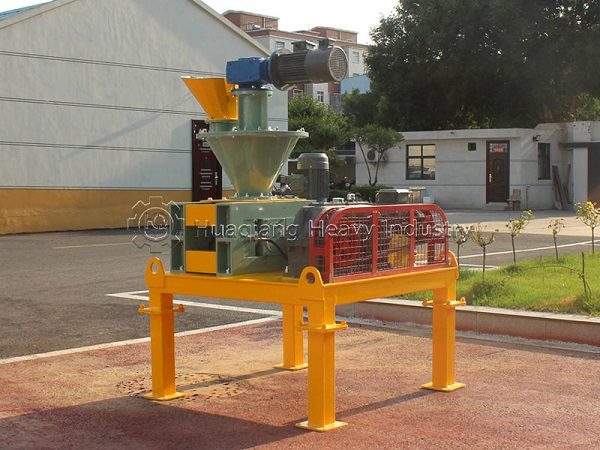
Hydraulic Roller Granulators in Complete NPK Lines
The precision and control of the hydraulic roller granulator make it an ideal core for a dry granulation section within a larger npk fertilizer line. After the material is compacted and formed by the granulator, it must be integrated into the broader finishing process. The dense, uniform flakes or granules from the roller press are first classified by a rotary drum screening machine to ensure size consistency. While this dry process often eliminates the need for a fertilizer dryer machine for moisture reduction, a fertilizer cooler machine is sometimes used to bring the granules to ambient temperature. Finally, the consistent, high-quality product is precisely weighed and bagged by a fertilizer packing machine. The integration of a hydraulic roller granulator into a complete npk fertilizer line offers a powerful, energy-efficient pathway for producing dense, high-strength granules, leveraging the hydraulic system’s superior pressure control for unparalleled product uniformity.