


Have you ever watched a chef toss ingredients into a bowl and mix them by hand? There’s something satisfying about seeing individual components—flour, sugar, salt—come together into a uniform blend. Now imagine doing that on an industrial scale, with tons of fertilizer ingredients, and you’ll understand the beauty of the NPK bulk blending machine.
Walk into a bulk blending facility, and you’ll see something that looks almost simple compared to the complex granulation lines nearby. No rotating drums for chemical reactions. No dryers or coolers. No massive towers. Instead, you’ll find a machine that does one thing and does it exceptionally well: mix granular ingredients into a perfectly uniform blend, quickly and gently.
What Is Bulk Blending?
Before we talk about the machine, let’s understand the product. Bulk blended fertilizer, often called BB fertilizer, is exactly what it sounds like: individual granular ingredients—urea, DAP, MOP, SSP, and sometimes micro-nutrients—physically mixed together. Unlike compound fertilizers where each granule contains all nutrients, BB fertilizer keeps ingredients separate. The farmer gets a bag or truckload of mixed granules that, when spread, deliver balanced nutrition.
Why do farmers love it? Flexibility. A blender can whip up any formula on demand: 20-20-10, 15-15-15, or something custom for specific crops and soils. No waiting for factory production runs. No committing to thousands of tons of one formula. Just mix what you need, when you need it.
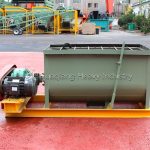
The Heart of the Operation
At the center of this flexibility sits the NPK bulk blending machine. Its design varies—horizontal mixer, vertical disc mixer—but the goal remains constant: uniform distribution without damaging granules.
The most common type? The rotating drum blender. Picture a large cylinder mounted on rollers, with internal flights or baffles arranged in a precise spiral pattern. As the drum rotates, material is lifted, carried, and cascaded in a controlled flow. The flights continuously divide and recombine the stream, ensuring every particle meets every other particle multiple times.
Load a batch into this drum—say, two tons of urea, one ton of DAP, one ton of MOP—and let it run for three to five minutes. Open the discharge gate, and what emerges is astonishingly uniform. Scoop a sample from anywhere in the pile, and the ratio of white urea to brown DAP to red MOP will match the original perfectly.
Why Gentle Matters
Here’s something important: granules are fragile. They’ve been carefully manufactured to certain sizes and hardness. Aggressive mixing that cracks or abrades them creates dust and fines, which lead to segregation during handling and uneven application in the field.
Good bulk blending machines respect this. They use just enough energy to achieve uniformity, but not so much that granules suffer. The rotating drum’s gentle tumbling action is ideal—it’s like rolling marbles in a barrel rather than beating them with a stick.
The Complete System
Of course, the blender doesn’t work alone. Behind it stands a thoughtfully designed system:
Weigh hoppers above the blender receive ingredients from storage bins, each one sitting on load cells that communicate with a central controller. The operator punches in a formula, and the system automatically draws the exact amounts needed—first urea, then DAP, then potash, then any micros or fillers.
Once weighed, materials drop into the blender for its mixing cycle. When finished, the batch discharges into a holding hopper or directly onto a conveyor leading to bagging or bulk truck loading. Some systems include post-blend screens to catch any oversize lumps or foreign material.
Flexibility That Matters
What makes bulk blending so appealing? Speed and adaptability. A blender can produce a dozen different formulas in a single shift, switching from one to the next with minimal cleanup. Need 10-10-10 for the wheat farmer this morning and 20-20-5 for the corn grower this afternoon? No problem. The control system stores hundreds of recipes; selecting one takes seconds.
This agility serves dealers and farmers well. Soil tests reveal specific needs, and within hours, custom-blended fertilizer is on its way to the field. No waiting weeks for factory production. No settling for “close enough” formulas.