
Choosing the right organic fertilizer granulator is a critical decision for your fertilizer plant, as it directly affects production efficiency, product quality, and long-term operational costs. With various types of granulators available—such as rotary drum granulator, disc granulator, and flat die pelleting machine—it’s easy to feel overwhelmed. This guide will help you make an informed choice based on your specific needs.
First, assess your production scale and capacity. If you run a small to medium-sized plant with a capacity of 500kg/h to 2T/h, a disc granulator or flat die pelleting machine is ideal. These machines are compact, easy to operate, and require less investment, making them perfect for startups. For large-scale plants with a capacity above 3T/h, a rotary drum granulator or double roller press granulator is more suitable, as they support continuous mass production and higher granulation rates.
Next, consider the raw materials you use. Organic fertilizer raw materials vary in moisture content and texture—for example, livestock manure has high moisture, while crop straw is drier. If your raw materials have a moisture content of 20%-40%, a new type organic fertilizer granulator (wet granulation) works best, as it uses wet continuous push rod technology to form uniform particles. For dry raw materials (moisture ≤5%), a hydraulic roller granulator (dry rolling granulation) is a better choice, as it compresses powder into particles without additional water.
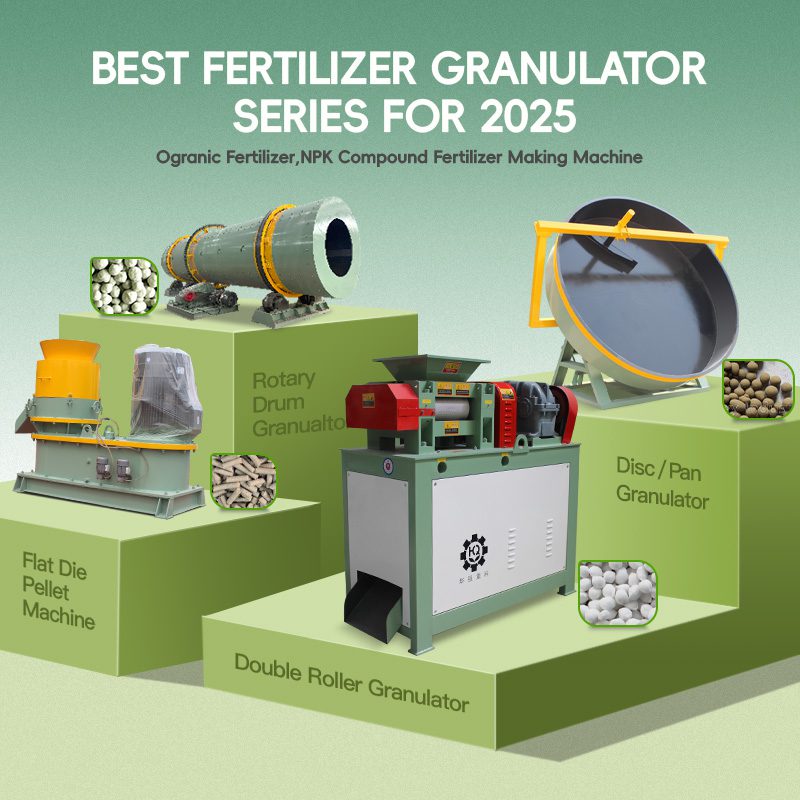
Don’t overlook the particle shape and application scenario. Cylindrical particles, produced by flat die pelleting machine or ring die granulator, are suitable for manual sowing and small-scale farming. Spherical particles, made by disc granulator or rotary drum granulator, have better fluidity and are ideal for large-scale mechanical sowing. If you need versatile equipment that can also produce feed particles, a multifunctional flat-die granulator is a great option.
Finally, consider maintenance and after-sales support. Choose a granulator with a simple structure—like cage crusher matching granulators—for easy cleaning and maintenance. Working with a reliable manufacturer like Huaqiang ensures you get professional installation, commissioning, and 24/7 technical support. By focusing on these factors, you can select a granulator that fits your plant’s needs and maximizes your return on investment.
The granulator selection guide emphasizes the need to consider the entire production ecosystem. For a bio organic fertilizer production line, where preserving microbial activity is paramount, the choice of granulator is critical. A disc granulator, with its gentle tumbling action, is often preferred over high-pressure methods. However, the post-granulation finishing steps are universal. After granulation, the product must be stabilized. A rotary drum screening machine classifies the granules, ensuring uniform size. A fertilizer dryer machine and fertilizer cooler machine then adjust the moisture and temperature for storage stability. Finally, a fertilizer packing machine seals the product. For producers creating complex blends, an npk blending machine can be integrated to precisely add mineral nutrients to the organic base. The integration of these essential finishing steps—screening, drying, cooling, and packaging—is common to all successful fertilizer lines, ensuring the final product meets market standards for quality and consistency. The granulator, whether a disc, drum, or roller press, is just one critical component in this integrated system.