


In the biomass energy value chain, the pelletizing stage serves as a pivotal link connecting upstream and downstream processes; the debate over the suitability of flat-die versus ring-die pellet mills is, at its core, an exercise in deciphering the complex physical properties of biomass feedstocks. Flat-die pellet mills—characterized by a horizontal, disc-shaped die and vertical pressure rollers—possess inherent advantages when processing biomass materials that are high in coarse fiber, low in bulk density, and poor in flowability. Agricultural and forestry residues such as sawdust, straw, rice husks, and peanut shells—which are often difficult to distribute evenly within high-speed ring-die equipment due to their loose structure and low natural binding capacity—find ideal forming conditions within the flat-die system, which utilizes vertical gravity feeding and low-speed extrusion. This advantage is no coincidence; it stems from the fact that the diameter of the flat-die pressure roller is not constrained by the die diameter itself, allowing for the use of larger bearings to enhance pressing force and deliver the substantial extrusion energy required to achieve target densities in coarse-fiber materials. In stark contrast, while ring-die pellet mills excel in processing refined animal feed, their high rotational speeds and relatively lower pressing forces often prove inadequate for lightweight materials like straw and sawdust, as centrifugal forces cause uneven distribution and hinder the material’s effective entry into the die holes.
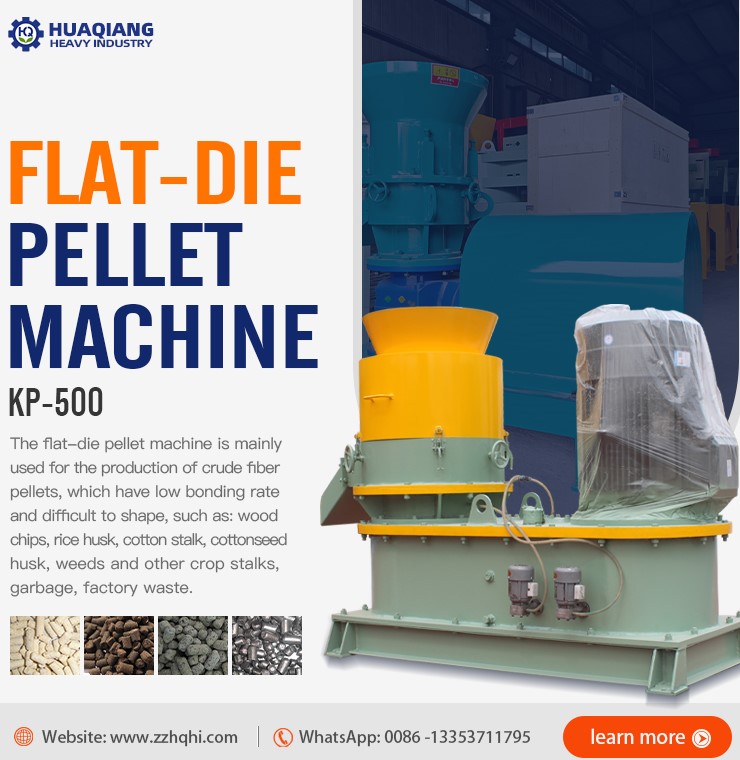
Ultimately, the difference in feedstock suitability between flat-die and ring-die pellet mills is not merely a matter of one being superior to the other, but rather a question of precisely matching equipment to material properties and process logic. With its natural affinity for coarse-fiber, low-density materials and a relatively flexible operating window, the flat-die mill is a pragmatic choice for small-to-medium-scale biomass pellet production lines. Meanwhile, the ring-die mill holds an irreplaceable position in large-scale industrial production, thanks to its ability to deliver high output, high density, and exceptional product consistency. Understanding this dialectical relationship requires moving beyond the mindset that prioritizes the equipment itself; instead, one must treat the feedstock’s fiber structure, moisture content, and particle size distribution as “first principles,” ensuring that equipment selection is dictated by material characteristics rather than the other way around. Only in this way can a truly scientific choice be made between two vastly different technical pathways, ensuring that every tonne of agricultural and forestry waste finds its way to high-value utilization through the pelletizer best suited to it.