

In the global wave of sustainable agricultural development, converting agricultural waste such as straw and livestock manure into high-value organic fertilizer is becoming a green growth point for more and more farms and agricultural enterprises. However, for small and medium-sized investors with limited budgets, how to build an efficient and stable composting production line while controlling costs is the key to the success or failure of the project. This article analyzes the core equipment configuration and construction techniques for agricultural waste composting production lines.
The core of agricultural waste composting production lies in the fermentation stage, and the synergy between the turning equipment and the raw material processing equipment is the core technology of the entire line. The turning equipment ensures the activity of aerobic microorganisms through forced ventilation and oxygen supply, shortening the fermentation cycle from 60 days in traditional natural composting to 20-30 days. The raw material processing equipment is responsible for crushing raw materials such as straw and manure to a suitable particle size (5-10mm) and precisely mixing them at a carbon-to-nitrogen ratio (C/N) of 25-30:1, creating optimal conditions for subsequent fermentation.
For small to medium-sized production lines with an annual output of 10,000-30,000 tons, a core combination of a windrow composting machine and a chain crusher is recommended. The windrow composting machine straddles the material pile for continuous composting, requiring low investment and energy consumption, and has minimal site requirements; it can operate directly on cement or mud floors. Its composting width can reach 2-4 meters, and its depth 1.2-1.5 meters, with a daily processing capacity of 80-200 tons per unit, fully meeting the needs of small to medium-scale production.
The chain crusher is responsible for raw material pretreatment, crushing straw, livestock manure, etc., to below 5mm, creating favorable operating conditions for the composting equipment. The crushed material has improved permeability, allowing for more complete oxygen penetration during composting and significantly improving fermentation efficiency. For fresh manure with high moisture content, a semi-wet material crusher can also be selected to directly process materials with a moisture content of 25%-30%.
Process optimization of agricultural waste composting production lines should adhere to a “subtraction-oriented” approach. After fermentation and composting, the material can be sold as powdered organic fertilizer after simple sieving, eliminating the need for granulation and drying. This reduces overall energy consumption by over 40% and equipment investment by 30%-50%. For granular production, a roller extrusion granulator (dry forming, no drying required) can be added later, offering controllable investment and flexible processing.
Scientifically setting the turning frequency also improves energy efficiency. During high-temperature periods (55-65℃), turning is done every 2 days; during cooling periods, it’s done every 5-7 days. This ensures sufficient oxygen supply while preventing excessive heat loss due to over-turning. A US study shows that using forced ventilation-assisted turning technology can shorten the composting cycle to 75% of conventional windrow methods.
The key to controlling investment lies in “high-end core equipment and sufficient auxiliary equipment.” It is recommended to use wear-resistant steel and reputable brand motors for the turning and crushing machines to ensure stable and reliable core components. Carbon steel can be used for conveying equipment, and regular anti-corrosion maintenance reduces costs. The site utilizes existing hardened ground, saving on civil engineering costs. Based on industry data, the investment for a small-scale production line with an hourly output of 1-2 tons is approximately US$20,000-40,000, while a medium-scale line with an hourly output of 3-5 tons is approximately US$50,000-80,000.
Our company offers the MS series of economical production lines for agricultural waste composting. The core configuration includes: a self-propelled windrow turner (2.5-meter turning width, 45kW power) + a chain crusher (3-5 tons per hour) + a drum screen. The equipment adopts a modular design, requiring only 300-500 square meters of space, and supports future expansion and upgrades. We provide a one-stop service from raw material analysis and process design to equipment installation and commissioning. Our engineers can provide on-site guidance overseas to ensure the production line is quickly put into operation and effective.
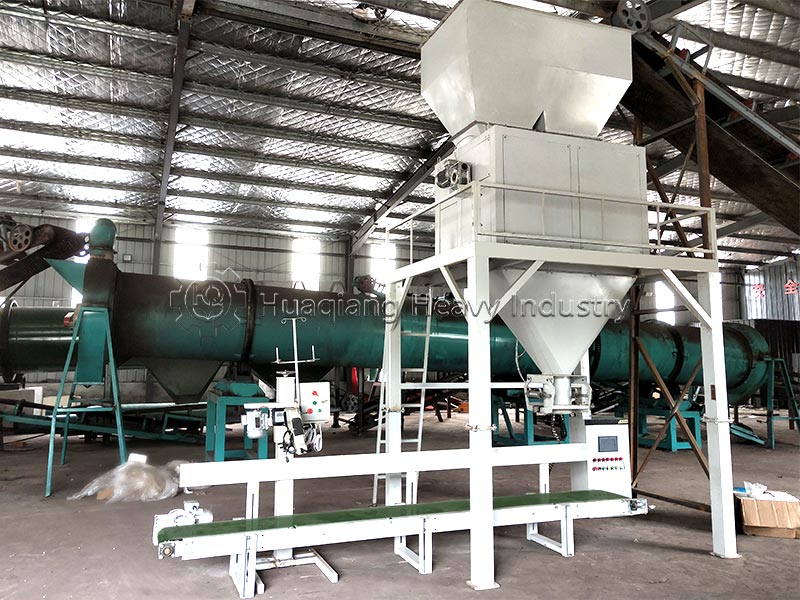
The core combination of a windrow composting machine and crusher forms the backbone of an efficient agricultural waste-to-fertilizer system. For operations seeking even more intensive and controlled composting, a double screws compost turning machine within a trough system offers an excellent alternative, providing enhanced aeration and mixing. After the composting process is complete, the material is ready for further refinement. If the goal is to produce a simple powdered organic fertilizer, the compost can be screened and packaged directly. However, for a higher-value granular product, the line can be expanded. The compost is fed into a disc granulator to form uniform pellets. These moist granules then enter a fertilizer dryer machine to reach the target moisture content, followed by a fertilizer cooler machine to prevent caking. A rotary drum screening machine classifies the granules, ensuring only uniformly sized product proceeds to the fertilizer packing machine for final bagging. This modular approach allows producers to start with a basic composting line and later upgrade to a full npk fertilizer line or organic granulation plant, scaling their investment as their business grows.