

Walk past a disc granulator in full swing, and you might mistake it for an artist’s studio. A large, tilted steel pan spins slowly, while inside, tiny balls of organic fertilizer grow like snowballs rolling down a hill. But do not let the gentle motion fool you this machine turns chicken litter and compost into perfect pellets, one lazy rotation at a time.
The scene starts further up the line. A chain crusher has already reduced fermented manure and straw into fine, fluffy powder. A vibrating screen has removed any rogue stones or plastic bits. Now a screw conveyor lifts the powder to a small hopper above the disc. A belt feeder meters the material onto the spinning pan – not too fast, not too slow. Water sprays from fine nozzles, misting the powder like morning dew on grass.
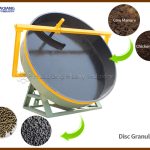
Here is the magic. The disc tilts at about 50 degrees. As it rotates, the powder sticks to itself, forming tiny nuclei. Those nuclei roll against the wet pan surface, picking up more powder, growing layer by layer. The old operator leaned against the railing and pointed at the pan. “See that? It is like making meatballs. Too dry, they crumble. Too wet, they turn into mud.” He reached in with a scoop and pulled out a handful of granules – round, uniform, each about the size of a pea. “That is three minutes of rolling. Another two minutes, they will be ready for harvest.”
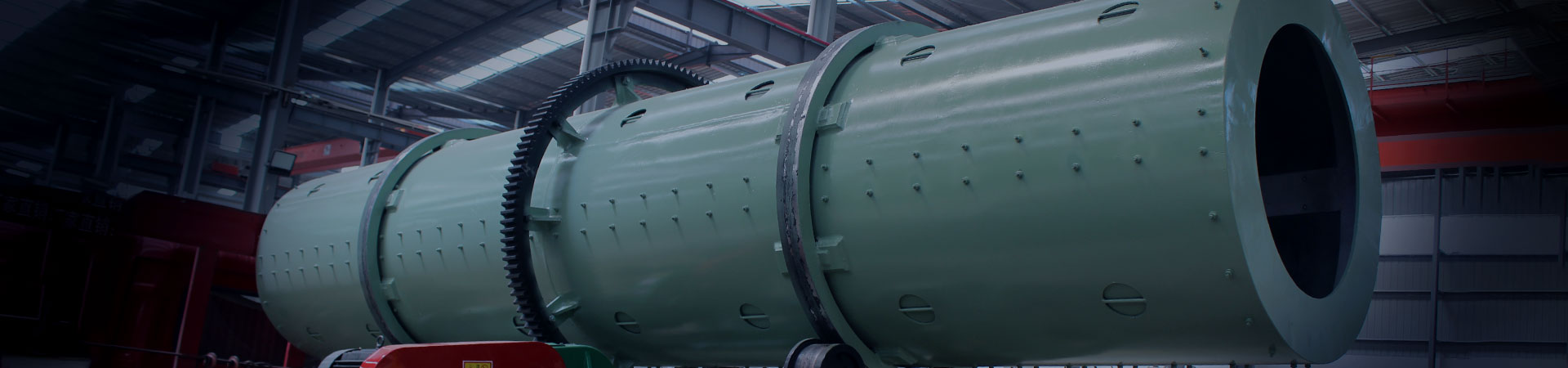
Around the disc granulator, the rest of the production line waits. A bucket elevator stands ready to lift the fresh granules to a rotary dryer. A cooler will follow, then a rotary screener machine to separate the perfect from the imperfect. The fines go back to the disc for another ride. But the disc itself never rushes. It just spins, sprays, grows.
Installation day was a lesson in angles. The disc’s drive shaft had to be aligned with the motor within half a millimeter. Too high, and the material would slide instead of roll. Too low, and the pan would scrape against its own frame. The fitter used a digital protractor to set the tilt, then checked it twice. A laser pointer marked the center of the pan. “If that dot wanders,” he said, “the granules will wander too – one side fat, one side skinny.”
The most nerve wracking moment was the first test with wet material. Water sprayed, powder fed, and for ten seconds nothing happened. Then a tiny ball appeared near the center. It rolled to the edge, picked up speed, and launched itself over the rim into a collection chute. Another followed, then a dozen, then hundreds. The old operator laughed. “There they go graduating class of today.”
Later, after the drum fertilizer dryer and cooler had done their work, the finished granules poured into a packing scale. They were hard, dark, and almost perfectly round. The bagging machine filled fifty kilo bags in seconds. The old operator grabbed one granule and crushed it between his fingers. It broke with a clean snap. “Good structure,” he said. “It will break down in soil, not in the bag.”
So why a disc instead of a drum or a roller press? The answer is gentleness. Organic fertilizer cannot be squeezed like chemical fertilizer it needs room to breathe, to grow slowly. The disc granulator gives it that room. Spin, spray, roll, grow. No crushing. No forcing. Just a pottery wheel for poop. And somehow, that works beautifully.