
Full Production Process: A complete bio-organic fertilizer production line typically includes seven core processes: fermentation → crushing → granulation → drying → screening → coating → packaging. Each step is closely integrated to complete the transformation from organic waste to commercial organic fertilizer.
Fermentation: Using livestock manure, straw, sludge, etc., as raw materials, microbial fermentation agents are added, and aerobic fermentation is carried out through turning and aeration. After 15-30 days of maturation, the material temperature drops, there is no odor, and the color turns dark brown, indicating that it has reached the maturity standard.
Crushing: The matured material may contain clumps or fibrous lumps, which need to be broken up using a semi-wet material crusher or chain crusher to ensure that the material fineness meets the granulation requirements (usually above 80 mesh).
Granulation: Depending on the material characteristics and finished product requirements, a disc granulator, a new type of organic fertilizer-specific granulator, or a rotary drum granulator is used to granulate the powder. Functional microbial agents can be added during the granulation process (attention should be paid to the temperature resistance of the microbial strains). Drying: Wet granules enter a rotary drying drum, where high-temperature hot air from a hot air furnace removes moisture. The drying temperature is controlled at 200-300℃, and the output moisture content is reduced to below 15%.
Cooling: The dried granules are still hot and need to be cooled to near room temperature by a rotary cooling drum to prevent clumping after packaging.
Screening: Granules are graded using a vibrating screen or rotary screen. Qualified granules (usually 2-5mm in diameter) proceed to the next process, while fine powder and large granules are returned to the granulator for reuse.
Coating and Packaging: Qualified granules enter a coating machine, where an anti-caking agent or functional coating material is sprayed on them. Finally, they are quantitatively packaged and sealed using an automatic packaging scale.
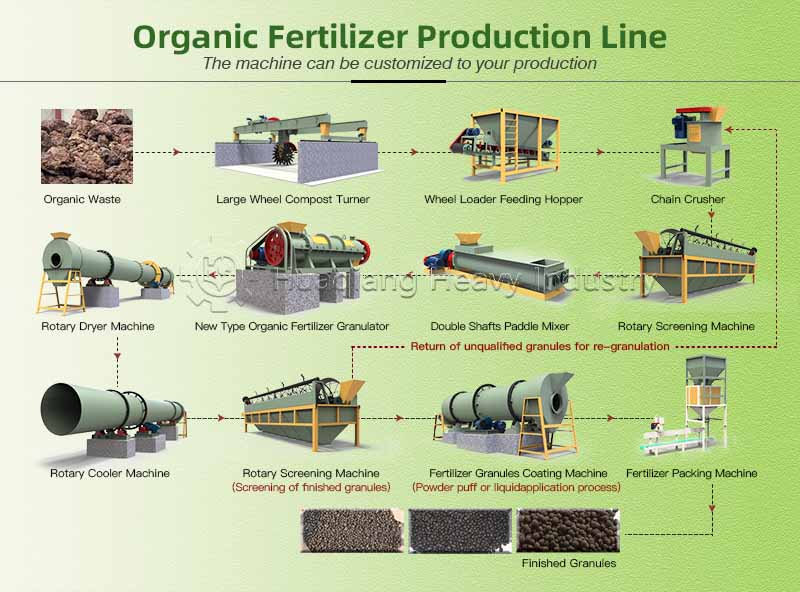
Core Equipment Matching
Each process has corresponding core equipment; proper matching is the guarantee for stable operation of the production line:
Fermentation Process
Recommended Equipment: Trench Turner, Windlass Turner, Double Helix Turner
Key Parameters: Turning depth 1.2-1.8 meters, processing capacity customized as needed
Crushing Process
Recommended Equipment: Semi-wet Material Crusher, Chain Crusher
Key Parameters: Output fineness ≤0.5 mm, moisture content tolerance 30%
Granulation Process
Recommended Equipment: New Organic Fertilizer Granulator, Disc Granulator, Rotary Drum Granulator
Key Parameters: Pelletizing rate ≥85%, particle diameter 2-6 mm adjustable
Drying Process
Recommended Equipment: Rotary Drying Drum
Key Parameters: Outlet material moisture ≤15%, hot air temperature 200-300℃
Cold Cooling Process
Recommended Equipment: Rotary Cooling Drum
Key Parameters: Outlet material temperature ≤40℃, cooling method: natural wind or forced wind
Screening Process
Recommended Equipment: Vibrating Screen, Rotary Screen
Key Parameters: Grading accuracy 2-5 mm, equipped with a return material system
Coating Process
Recommended Equipment: Rotary Coating Machine
Key Parameters: Uniform spraying, microbial agents or anti-caking agents can be added
Packaging Process
Recommended Equipment: Automatic Quantitative Packaging Scale
Key Parameters: Weighing error ≤0.2%, sealing method: sewing or heat sealing
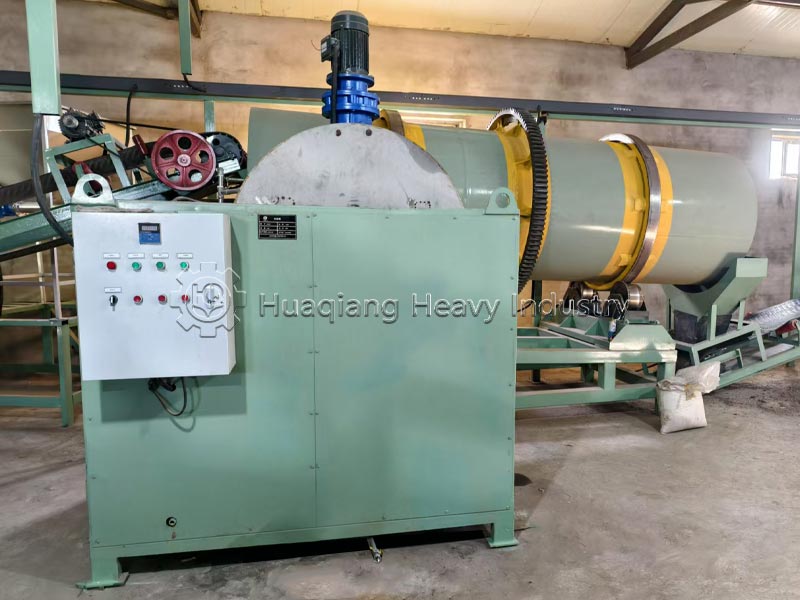
Auxiliary Equipment
Includes: Conveyors (belt conveyors or bucket elevators), dust collectors (combination of cyclone dust collector and water bath dust collector), hot air furnaces (fuel options: coal, gas, or biomass), electrical control system (PLC automatic control). Customized Production Line Design Different users have significantly different raw material characteristics and production capacity requirements, necessitating targeted production line design:
Raw Material Adaptation: High-fiber materials (straw, coconut coir) require enhanced crushing processes; a two-stage crusher can be configured. High-moisture materials (fresh chicken manure) require the addition of auxiliary materials before fermentation or an extended fermentation time.
Production Capacity Design: Small lines with an annual output of less than 5,000 tons can adopt intermittent production, with smaller crushing, granulation, and screening equipment. Drying and cooling can be carried out in sections using shared rollers. Medium-sized lines with an annual output of 10,000-30,000 tons are recommended to have a fully continuous configuration, with independent equipment for each process for higher efficiency. Large lines with an annual output of over 50,000 tons require automated batching, central control, and automatic packaging and palletizing systems.
Functional Expansion: For the production of bio-organic fertilizer (with added functional bacteria), low-temperature drying should be used after granulation, or bacterial agents should be sprayed directly during the coating process to avoid killing live bacteria with high temperatures. For the production of organic-inorganic compound fertilizer, an inorganic fertilizer mixing process needs to be added after fermentation.
The seven core processes of a bio organic fertilizer production line are: fermentation → crushing → granulation → drying → screening → coating → packaging. For an npk fertilizer line, the process is similar but often includes additional steps for inorganic nutrient incorporation. For a roller press granulator production line, a double roller press granulator is used for dry compaction, eliminating the drying step. A disc granulator is a common choice for wet granulation in organic lines. After granulation, the material is processed through a fertilizer dryer machine and a fertilizer cooler machine to stabilize moisture and temperature. A rotary drum screening machine classifies the granules, and a fertilizer packing machine seals the final product. Core equipment matching is critical: fermentation (trench or windrow turner), crushing (semi-wet or chain crusher), granulation (new type, disc, or drum granulator), drying (rotary drum, 200-300°C), cooling (rotary drum, to ≤40°C), screening (vibrating or rotary screen, 2-5 mm), coating, and packaging. For bio-organic fertilizer, low-temperature drying or post-drying coating of microbial agents is essential to preserve viability. For organic-inorganic compound fertilizer, an additional mixing process for inorganic nutrients is required. Customized production line design must consider raw material characteristics (fiber content, moisture), production capacity (small <5,000 t/year, medium 10,000-30,000 t/year, large >50,000 t/year), and product positioning (bio-organic, organic-inorganic). A well-designed line optimizes equipment matching, reduces operating costs, and ensures high product quality. Contact us for a customized configuration plan, including free trial runs with your raw materials.
A well-designed bio-organic fertilizer production line should comprehensively consider raw material characteristics, target capacity, product positioning, and investment budget. Contact us to obtain a customized production line configuration plan. We can also provide raw material samples and offer free trial runs, allowing you to see the results firsthand. A proper combination of organic fertilizer production equipment can effectively reduce operating costs and improve the quality of the finished product.