
If you stand inside a production workshop for organic or compound fertilizer, the first time you see a vertical disc mixer, you might pause. Isn’t that just a huge disc tilted upright, turning slowly? Don’t underestimate it. This seemingly clumsy “big plate” is actually the dough master of the whole production line. Without it, all the subsequent granulating, drying, and screening would be helpless against clumped raw materials.
The working principle of a vertical disc mixer sounds like a slow motion dance: a motor drives a reducer, which spins the disc in a vertical plane. Inside the disc, several fixed scrapers or lifters are welded. When raw materials fall from the inlet to the bottom of the disc, the scrapers scoop them up again and again, carry them to a higher point, and let them fall naturally. The material tumbles, convects, and shears repeatedly inside the disc. Within minutes, the “gang” of powders, small particles, and liquid additives is broken apart and reassembled into a loose, uniform mixture. The whole process has no violent squeezing, yet carries a gentle power like a palm pushing silk.
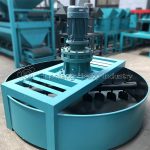
At the installation site, workers are busy around this iron plate more than two meters in diameter. The base must be absolutely level, otherwise the disc will wobble like a drunkard when it spins. An old hand measures repeatedly with a spirit level, shouting, “The east side is 0.5 mm too high. Add one more shim.” Several young workers kneel beside the anchor bolts, tightening each nut with a torque wrench and marking after every turn. The fit between the disc’s bearing housing and the main shaft must be perfect. If the clearance deviates by more than 0.1 mm, the whole machine will rattle or even seize up within half a year.
Apart from the vertical disc mixer itself, this fertilizer production line cannot do without several old partners. Upstream are the automatic batching scale and the crusher: the batching scale weighs nitrogen, phosphorus, potassium, and various additives according to the formula, while the crusher grinds clumped materials into fine powder. Downstream from the mixer are the disc granulator or drum granulator, the drum fertilizer dryer, the cooler, the screener, and the packaging scale. All equipment is linked by belt conveyors or bucket elevators into a single flow line, from powder to bagging, without a hitch.
On test day, workers pour several tons of blended powder into the mixer. They start the machine. The disc turns slowly, at first only a low hum from the motor. A few seconds later, the material inside begins to surge, flowing like magma at the mouth of a volcano, then rolling back like waves hitting a reef. The inspection door opens. The old hand quickly scoops out a sample with a sampling shovel, spreads it on his palm, squints at the color, and feels the texture. “Uniform, no lumps. Ready to feed the granulator.” A young worker jokes, “This is even smoother than my mother kneading dough.”
What makes the vertical disc mixer so valuable is that it is great wisdom appearing simple. It does not chase speed or make much noise. It does only one thing: blending all kinds of raw materials into one heart. Without it, the granulator would clog, the dryer would scorch material, and the finished pellets would be patchy, white here and black there. With it, the whole production line gets a true opening act.
So next time you see that quiet, spinning disc in the workshop, do not think it clumsy. The steadier it turns, the more beautiful the pellets that come out later. With a solid base, the dream of a rich harvest finally takes root.