
In fertilizer production, granulation processes are mainly divided into wet granulation, dry extrusion granulation, and hot melt granulation.
Common granulators include the following:
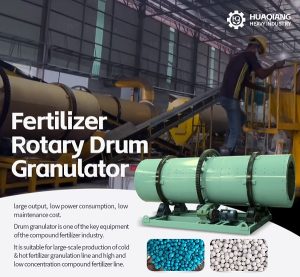
- Working Principle: Utilizing the gravity and centrifugal force of the material, steam or water is introduced into a rotating drum, causing the material to agglomerate into granules (agglomeration method).
- Applicable Materials: Large-scale production of compound fertilizers, blended fertilizers, phosphate fertilizers, nitrogen fertilizers, and other inorganic fertilizers.
- Advantages:
- High production capacity, suitable for large-scale industrial production (10,000-200,000 tons per year).
- Steam is constantly introduced into the drum, raising the material temperature, which is beneficial for granulation.
- The drum lining (such as rubber sheet or stainless steel) has good anti-sticking effect, making the equipment durable.
- Disadvantages: Large footprint, high equipment investment, and pelleting rate greatly affected by operating techniques (usually around 70%-80%, ungranulated material needs to be recycled).
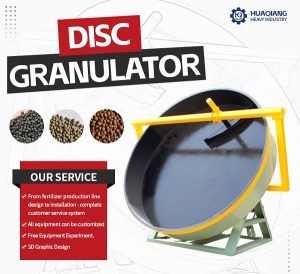
- Working Principle: Material rotates in an inclined disc. A binder (water or film-forming agent) is sprayed, causing the material to continuously grow and form larger particles as it rolls. Qualified particles overflow from the edge of the disc due to gravity.
- Applicable Materials: Organic fertilizer, organic-inorganic compound fertilizer, feed, clay, etc.
- Advantages:
- Adjustable disc angle and rotation speed; intuitive pelleting and grading; high pelleting rate (up to 93% or more).
- Simple structure, convenient operation and maintenance, low investment cost.
- Disadvantages: Relatively high dust levels; lower production efficiency than rotary drum granulators; not suitable for ultra-large-scale production.
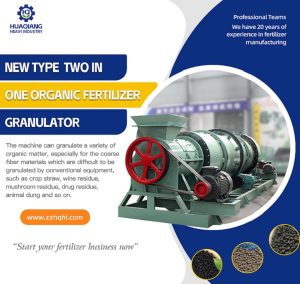
- Working Principle: Utilizes high-speed rotating mechanical stirring force and the resulting aerodynamics to continuously mix, granulate, pelletize, and densify fine powder materials within the machine.
- Applicable Materials: Pure organic fertilizer, livestock and poultry manure, fermented straw, humic acid, and other lightweight powders that are difficult to granulate.
- Advantages:
- Particularly suitable for organic materials, granulation can be performed without the addition of binders.
- Extremely high granulation rate (up to 95% or more), particle strength higher than disc granulators.
- Disadvantages: Relatively high power consumption, faster wear of the stirring teeth and lining, requiring regular maintenance.
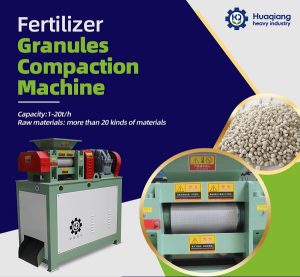
- Working Principle: A dry granulation method. Material is directly extruded through two opposing rotating rollers at room temperature to form a flat slab, which is then crushed and screened to obtain granules.
- Applicable Materials: Inorganic salt fertilizers such as ammonium sulfate, potassium chloride, urea, and ammonium bicarbonate, either single-element or compound fertilizers.
- Advantages:
No drying or cooling process required, short process flow, significantly saving energy (low energy consumption).
- Low investment, small footprint.
- Particularly suitable for heat-sensitive materials or materials that cannot be mixed with water.
- Disadvantages: Particle shape is usually irregular, flattened spherical or cylindrical (poor roundness), and particle strength is greatly affected by the material ratio.
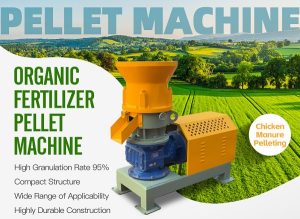
- Flat Die/Ring Die Pellet Mill
- Working Principle: Material is forcibly squeezed through the holes of the die by pressure rollers, cut into cylindrical particles.
- Applicable Materials: Bio-organic fertilizer, feed, coarse fiber materials (such as sawdust, straw).
- Advantages:
Almost 100% forming rate, high particle density, extremely high strength.
- Suitable for materials with high fiber content.
Disadvantages: Relatively low output; molds and rollers are prone to wear, making them vulnerable parts; and cylindrical granules are less accepted in some fertilizer markets than spherical granules.
How to Choose a Fertilizer Granulator? (Selection Guide) Choosing the right granulator requires comprehensive consideration of material characteristics, output requirements, granule quality requirements, and investment budget.
The following are specific selection dimensions:
- Selection Based on “Material Properties”
- Pure inorganic chemical fertilizers (e.g., NPK compound fertilizer, urea, potash fertilizer):
- First choice: Drum granulator (large-scale) or roller extrusion granulator (no drying, small to medium scale).
- Pure organic fertilizers/bio-organic fertilizers (e.g., chicken manure, cow manure, humic acid, sludge):
- First choice: New type wet-process stirring toothed granulator or disc granulator. If the material has a lot of fiber and requires high density, a flat die/ring die granulator can be selected.
- Organic-Inorganic Blended Fertilizer:
- Recommended: Rotary drum-stirring tooth granulator (combining the high granulation rate of stirring teeth and the roundness of a rotary drum).
- Selection Based on “Production Scale”:
- Annual production below 10,000 tons (small scale): Disc granulator or roller extrusion granulator is preferred. Low equipment investment and fast capital recovery.
- Annual production of 10,000-50,000 tons (medium scale): New type wet stirring tooth granulator or medium-sized rotary drum granulator is recommended.
- Annual production above 50,000 tons (large scale): Rotary drum granulator unit is mandatory.
- Selection Based on “Process Energy Consumption and Investment Budget”:
- Limited budget, no desire to configure dryer and cooler:
- Roller extrusion granulator is mandatory. It is the only equipment that can granulate dry powder at room temperature without subsequent drying.
- Achieving Granulation Roundness and Product Appearance:
- Choosing disc granulation or agitator granulation, and equipping it with a spheronizer, can shape coarse granules into very round spheres.
III. Technical Risk Warnings and Optimization Suggestions
- Moisture Control (Key to Wet Granulation): When using disc or drum granulation, the moisture content of the material entering the machine usually needs to be controlled between 15% and 25%. Too low a moisture content makes granulation difficult, while too high a moisture content will cause the granules to stick to the walls and agglomerate. It is recommended to install an automatic moisture measurement and spray control system before granulation.
- Material Corrosion Resistance and Wear Resistance: Fertilizer materials (such as ammonium chloride, urea, or acidic organic fertilizers) are usually corrosive. Optimization suggestion: Parts in contact with the material (such as the granulator lining, agitator, and roller skin) should be made of 304/316L stainless steel or treated with an anti-corrosion and wear-resistant coating to extend the equipment’s lifespan.
- Dust and Environmental Protection: Dry extrusion and disc granulation easily generate dust. It is recommended to install cyclone dust collectors or pulse bag dust collectors at the granulator discharge port and screening machine to meet environmental protection requirements and recover powder materials.